
AI Search Visibility in 2026: 9 Ways to Get Your Brand Cited
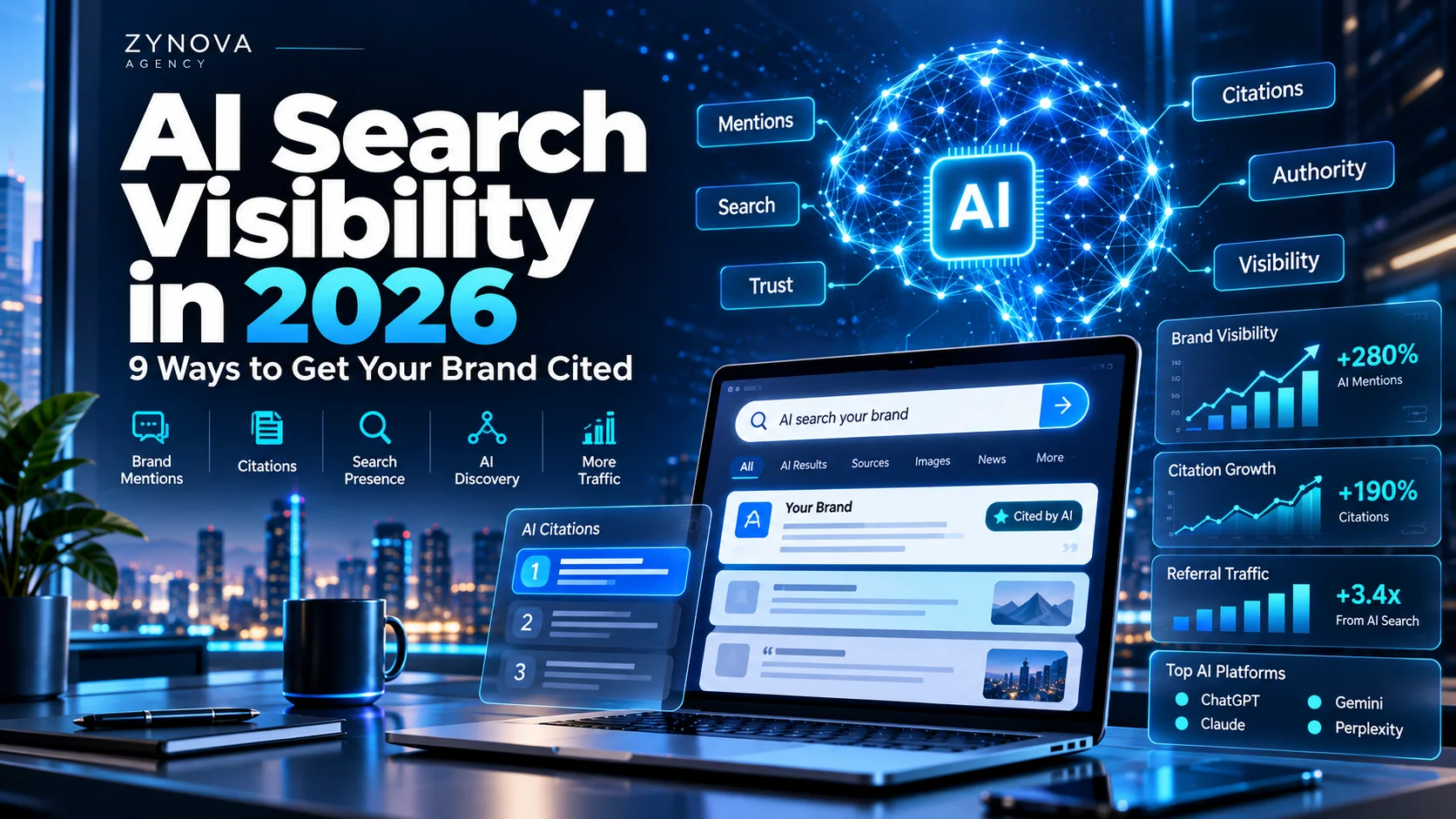
AI search visibility is becoming a major part of SEO in 2026. Customers now discover brands through Google AI Overviews, AI Mode, ChatGPT, Gemini, Claude, Perplexity, and other answer engines. Therefore, businesses need to understand whether their brand appears when people ask AI systems for recommendations, comparisons, and solutions.
Traditional rankings still matter. However, AI visibility adds a second question: does an AI system mention, cite, or recommend your website when it answers a relevant query? This guide explains how to measure that visibility and improve it with practical SEO work.
What Is AI Search Visibility?
AI search visibility describes how often a brand, website, product, or page appears inside AI-generated search experiences. That appearance can take several forms.
- Your page may appear as a cited source.
- Your brand may be mentioned in an AI answer.
- Your product may appear in a comparison.
- Your article may support an AI Overview.
- Your website may receive referral traffic from an AI assistant.
In short, the goal is not only to rank. The goal is to become a useful source that AI systems can retrieve and reference.
If you want to understand the wider strategy, our AEO for small business guide explains how answer-focused optimization fits into modern search.
Why AI Search Visibility Is Growing
AI search is no longer a small experiment. Google reported that AI Mode passed one billion monthly users in 2026. At the same time, users are asking longer and more complex questions.
This shift creates new opportunities. A user might ask, “What is the best CRM for a small service business with three salespeople?” Instead of browsing ten blue links, the user may receive a summarized answer with several sources.
As a result, brands can gain exposure before the user visits a website. That makes AI visibility important for awareness, trust, and future conversions.
1. Measure Your Current AI Visibility
Start with a baseline. Otherwise, you will not know whether your work is improving results.
Create a simple list of high-value questions related to your business. Then test those questions across the AI platforms your audience is likely to use.
Track:
- whether your brand appears;
- which competitors appear;
- which sources are cited;
- which pages receive AI referral traffic;
- which topics trigger AI mentions;
- how visibility changes over time.
For larger tracking projects, our guide to the best AI visibility tools compares platforms that monitor mentions and citations.
2. Publish Content That Answers Specific Questions
Broad pages can still perform well. However, specific questions often reveal stronger user intent.
For example, a digital agency could publish content around questions such as:
- How much should a small-business website cost?
- What should a local SEO package include?
- When should a business use an AI chatbot?
- Which automation tasks save the most time?
Each page should answer the main question clearly. Then it should explain the reasoning, provide examples, and guide the reader toward a useful next step.
3. Add Original Information
AI systems can summarize generic content easily. Therefore, original information helps a page stand out.
Useful additions include:
- first-hand testing;
- client questions;
- case studies;
- before-and-after results;
- original screenshots;
- pricing observations;
- process checklists;
- industry-specific examples.
Google’s current AI search guidance encourages useful, unique, non-commodity content. In other words, do not simply rewrite what every competitor already says.
4. Make Your Brand Easy to Understand
AI search systems need clear context about who you are and what you do. For that reason, keep your business information consistent.
Your website should clearly explain:
- business name;
- services;
- locations served;
- industry focus;
- contact details;
- team or author information;
- policies and important business details.
For local businesses, update the Google Business Profile as well. Consistent information reduces confusion and strengthens your overall search presence.
5. Improve Internal Linking
Internal links connect related topics and help users move through your website. They also give search systems more context.
For example, a page about AI visibility can link naturally to SEO tools, website SEO improvements, and relevant service pages.
Use descriptive anchor text. Meanwhile, avoid adding links only because you want to increase the link count. Every link should help the reader.
6. Keep Pages Crawlable and Indexable
Strong content cannot appear in search if crawlers cannot reach it. Therefore, technical SEO remains essential.
Check:
- robots.txt rules;
- indexing status;
- canonical tags;
- XML sitemaps;
- internal links;
- page speed;
- mobile usability;
- server errors.
Google says pages must be indexed and eligible for Search snippets before they can appear as supporting links in AI Overviews or AI Mode.
7. Support Claims With Reliable Sources
Trustworthy pages explain where important facts come from. Consequently, link to primary or authoritative sources when you discuss changing data, product features, research, or official guidance.
For example, SEO guidance should link to Google Search Central when relevant. Likewise, product claims should point to the provider’s official documentation when possible.
Good sourcing helps readers verify your claims. It also makes the page more useful than an unsupported summary.
8. Use Structured Data Where It Fits
Structured data can describe page content and entities in a machine-readable format. However, it is not a guaranteed AI citation trick.
Use supported schema types when they match the visible page, such as:
- Organization;
- LocalBusiness;
- Article;
- Product;
- Breadcrumb;
- VideoObject.
Google states that no special schema is required for AI Overviews or AI Mode. Therefore, focus on accurate markup rather than adding unnecessary schema.
9. Update Content and Track Changes
AI search changes quickly. As a result, older pages may need more frequent review.
Update content when:
- prices change;
- software features change;
- new official guidance appears;
- screenshots become outdated;
- a competitor changes positioning;
- new questions appear in Search Console;
- important links stop working.
After each meaningful update, track impressions, clicks, AI mentions, and referral traffic. That process helps you identify which changes actually improve visibility.
How to Measure AI Search Visibility
| Metric | What It Shows | Where to Check |
|---|---|---|
| AI mentions | How often your brand appears in answers | AI visibility tools or manual checks |
| Citations | Which pages AI systems reference | AI platforms and monitoring tools |
| AI referral traffic | Visits coming from AI assistants | Analytics |
| Generative AI impressions | Visibility in Google’s generative features | Google Search Console |
| Organic clicks | Traditional search performance | Google Search Console |
| Conversions | Business value from search visitors | Analytics or CRM |
AI Search Visibility vs Traditional Rankings
These two metrics should work together, not compete with each other.
A page can rank well but receive fewer clicks if an AI answer solves the user’s question immediately. On the other hand, a brand may gain useful exposure when an AI system mentions it even before a click happens.
Therefore, modern reporting should include both ranking metrics and AI visibility metrics.
Common AI Visibility Mistakes
Tracking Only One Prompt
One prompt cannot represent an entire market. Instead, track a group of questions across different stages of the customer journey.
Ignoring Conversions
More mentions do not automatically mean more revenue. Therefore, connect visibility data with leads, sales, and other business goals.
Publishing Generic Content
Thin summaries add little value. Add examples, original insights, and useful details that competitors have missed.
Using Unproven Shortcuts
No file or schema type can guarantee AI citations. Focus on useful content, technical access, trust, and strong SEO fundamentals.
AI Search Visibility Checklist
- Define the questions your audience asks.
- Check whether your brand appears today.
- Review which competitors receive citations.
- Publish direct and useful answers.
- Add first-hand experience and original information.
- Strengthen internal links.
- Keep important pages crawlable and indexable.
- Use accurate structured data where appropriate.
- Link to reliable sources.
- Track AI mentions, citations, traffic, and conversions.
Frequently Asked Questions
What is AI search visibility?
AI search visibility measures how often a brand, website, or page appears in AI-generated answers, citations, recommendations, and AI-powered search features.
How can I improve AI search visibility?
Create useful content, answer specific questions, add original information, improve technical SEO, strengthen internal links, support claims with reliable sources, and track results over time.
Does normal SEO still matter for AI search?
Yes. Google says its generative AI search features still rely on core Search ranking and quality systems. Therefore, strong SEO remains the foundation.
Can a small business appear in AI answers?
Yes. Small businesses can improve their chances by publishing focused expertise, keeping business information clear, and answering questions that larger sites may cover only broadly.
Do I need a paid AI visibility tool?
No. You can start with manual testing, analytics, and Search Console. Paid tools become more useful when you need larger-scale tracking across many prompts and platforms.
Final Thoughts
AI search visibility is becoming a practical SEO metric in 2026. Businesses should still care about rankings and traffic, but they should also track where AI systems mention and cite their brand.
Start with strong SEO foundations. Next, publish useful answers, add original value, make your expertise easy to verify, and measure changes over time. This approach gives your brand more opportunities to appear wherever customers search.
If you need help building a broader strategy, explore Zynova Agency’s SEO and digital growth services.
Sources: Google Search Central’s generative AI optimization guide and Search Console generative AI performance reporting.