AEO for Small Business in 2026: How to Get Found in AI Search
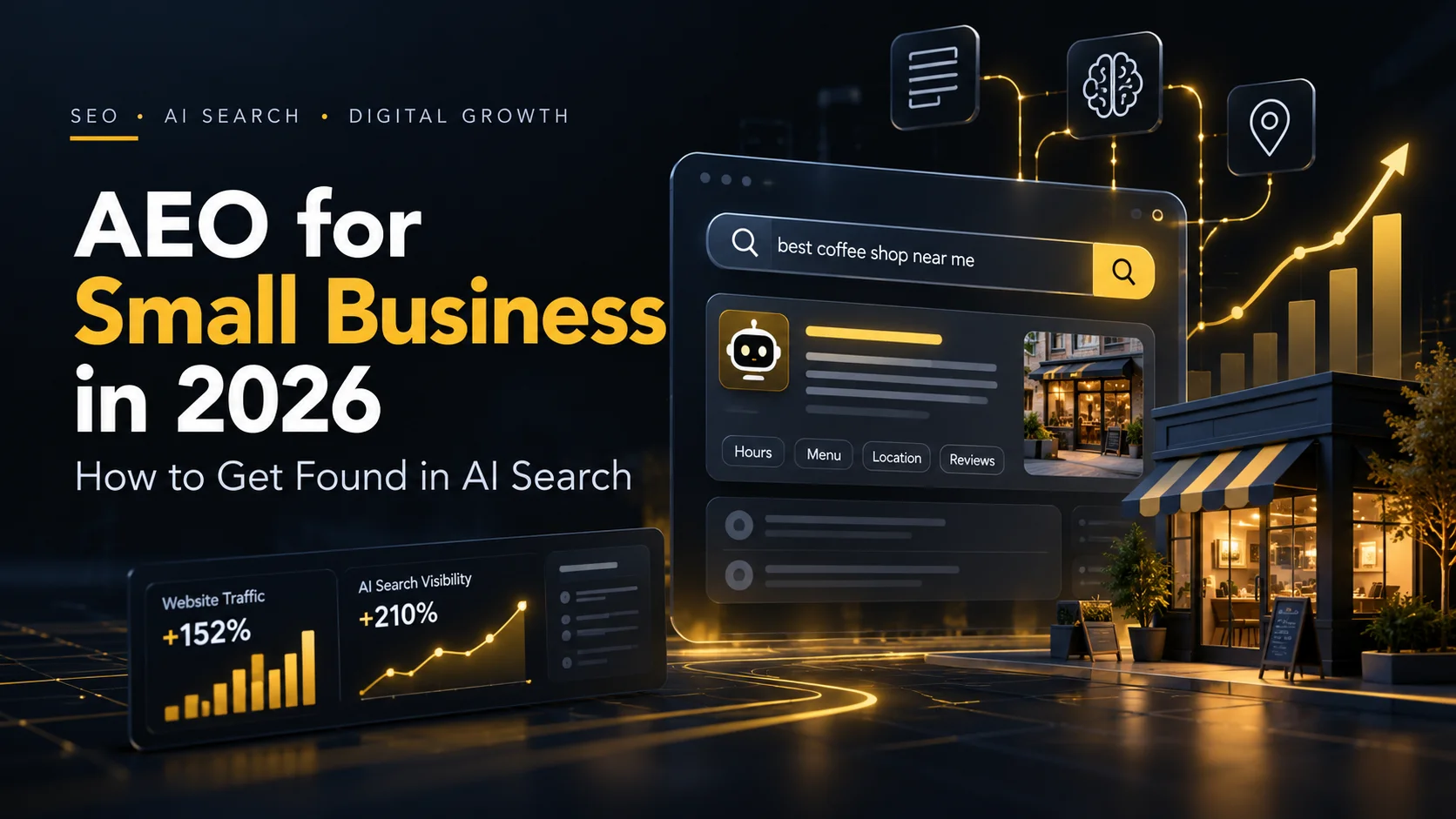
Search is changing fast. Customers no longer rely only on a list of blue links—they increasingly ask ChatGPT, Google AI, Microsoft Copilot, Perplexity, and other answer engines for direct recommendations.
That is why AEO for Small Business matters in 2026. Answer Engine Optimization helps make your website easier for AI-powered search systems to discover, understand, trust, and cite when people ask questions related to your products or services.
The goal is not to “trick” AI. The goal is to make your business clear, useful, verifiable, and technically accessible so both traditional search engines and AI answer systems can confidently use your content.
Quick Answer
AEO for Small Business means optimizing your website and online presence so AI-powered search tools can understand what your business does and cite or recommend it for relevant questions. Strong AEO still depends on solid SEO: crawlable pages, helpful content, clear business information, trustworthy sources, structured data where useful, and consistent signals across the web.
What Is AEO for Small Business?
AEO stands for Answer Engine Optimization. It focuses on improving how your business appears in AI-generated answers rather than only trying to rank a web page in traditional search results.
For example, a customer might ask:
- “Which web development agency is best for a small business?”
- “What is the best POS system for a restaurant?”
- “Who can automate customer support for my company?”
- “What SEO service should a local business use?”
An answer engine may respond with a short explanation, a few recommended businesses, and citations. AEO increases the chance that your content is understandable and useful enough to become one of those sources.
Google’s official 2026 guidance makes an important point: AI visibility does not replace SEO. Google says its generative AI search features still rely on its core search systems, crawlable content, indexing, quality signals, and useful pages. You can read.
AEO vs SEO: What Is the Difference?
SEO and AEO overlap, but they are not exactly the same.
| Area | Traditional SEO | AEO |
|---|---|---|
| Primary goal | Rank pages in search results | Be cited, summarized, or recommended in AI answers |
| User behavior | Clicks links and compares pages | Asks a question and receives a synthesized answer |
| Content style | Keyword- and topic-focused pages | Clear, direct, well-supported answers to real questions |
| Measurement | Rankings, impressions, clicks, conversions | Citations, mentions, AI visibility, assisted conversions |
The best strategy is not choosing one over the other. For most businesses, AEO for Small Business works best as an extension of strong SEO.
Why AEO Matters More in 2026
AI search is becoming a normal part of how people discover companies, compare tools, research services, and make buying decisions.
HubSpot’s 2026 AEO research reports that 58% of marketers say their businesses are already optimizing content for answer engines. The same report also says 44% of marketers have made a business purchase based on brands discovered through answer engines.
Bing has also added AI-specific visibility reporting to Bing Webmaster Tools. Its AI Performance reports show citations, cited pages, grounding queries, topics, and other signals related to Microsoft Copilot and AI-generated Bing experiences.
This matters for small businesses because AI answers can influence a customer before that person ever reaches your website.
AEO for Small Business: 9 Practical Ways to Improve AI Visibility
1. Make Every Important Page Easy to Understand
Start with clarity.
Your homepage and service pages should make it obvious:
- What your business does
- Who you help
- Where you operate
- What makes your service different
- How customers can contact you
A vague homepage full of slogans gives search systems less useful information than a page that clearly explains the business.
For example, “We build digital experiences” is weaker than “We build WordPress websites and custom business software for small and growing companies.”
2. Answer Real Customer Questions Directly
AI systems are built around questions and answers. Your content should reflect the questions customers actually ask.
Create pages and articles that answer specific problems such as:
- How much does a small business website cost?
- What is the best POS system for a restaurant?
- Can AI automate customer support?
- How long does SEO take for a local business?
- What is the difference between custom software and SaaS?
Give the answer early, then explain the details. Do not force users to read 800 words before you answer the question.
3. Build Topical Authority Instead of Publishing Random Posts
A strong AEO for Small Business strategy needs subject depth.
If your business wants visibility around AI automation, publish a connected set of useful resources covering workflows, AI agents, customer service automation, lead automation, CRM automation, implementation costs, security, and real business use cases.
This is better than publishing unrelated trending topics simply because they have search volume.
For businesses developing a complete search strategy, Zynova Agency’s SEO & Digital Growth services focus on building visibility around the topics that matter to the business.
4. Add Evidence, Examples, and Original Information
Generic content is easy to reproduce. Original information is harder to replace.
Where possible, strengthen your pages with:
- Real examples
- Original screenshots
- Case studies
- Pricing explanations
- First-hand experience
- Before-and-after workflows
- Original data or observations
Google’s 2026 AI search guidance specifically encourages valuable, non-commodity content rather than pages that simply repeat what already exists online.
If your article could be replaced by a generic paragraph from any competitor, it probably needs more useful detail.
5. Keep Your Business Information Consistent
AI systems may compare information from your website with other sources.
Your company name, service descriptions, phone number, address where relevant, social profiles, business categories, and other key facts should be consistent.
For a local company, keep information current in important business listings and profiles. For service businesses, make sure your About, Contact, service, and profile pages describe the same company accurately.
Consistency reduces ambiguity and makes it easier for search systems to understand the entity behind the website.
6. Use Structured Data Where It Actually Helps
Structured data helps search engines understand page types and entities, but it is not a magic AEO shortcut.
Use appropriate schema where relevant, such as:
- Organization
- LocalBusiness
- Article
- BreadcrumbList
- Product
- SoftwareApplication
- VideoObject
Google explicitly says there is no special AEO or generative-AI schema required for its AI features. Continue using structured data as part of normal SEO, not as a trick to force AI citations.
7. Make Sure Google and Bing Can Crawl the Site
No content strategy can work properly if search engines cannot access the page.
Check that important pages:
- Return a normal 200 status code
- Are not accidentally marked
noindex - Are not blocked by robots.txt
- Use the correct canonical URL
- Appear in your XML sitemap
- Load properly on mobile
- Do not depend on broken scripts to show the main content
This is especially important for Bing. Bing says AI Performance data only reflects content that is eligible for indexing and that it respects robots.txt and other supported publisher controls.
8. Use IndexNow for Faster Bing Discovery
For WordPress sites, IndexNow can help notify participating search engines when a page is added, changed, or removed.
Bing strongly recommends IndexNow for faster automated URL submission. It does not guarantee indexing, but it can help search engines discover fresh changes sooner.
Rank Math supports IndexNow, so WordPress businesses using Rank Math may already have an easy path to enable it.
9. Measure AI Visibility, Not Only Google Rankings
Traditional rankings still matter, but they no longer tell the whole story.
In 2026, businesses should also monitor:
- Which pages are cited in AI answers
- Which topics generate citations
- Which questions or grounding queries surface the site
- Brand mentions in answer engines
- Traffic arriving from AI platforms
- Leads that mention ChatGPT, Copilot, Gemini, or Perplexity
Bing Webmaster Tools now provides an AI Performance report specifically for this purpose.
Google Search Console also introduced dedicated reporting for generative AI visibility in Search and Discover during 2026.
A 30-Minute AEO Audit for a Small Business Website
You do not need an expensive tool stack to perform a useful first audit.
Open your website and check the following:
- Homepage: Can a new visitor understand what the business does within a few seconds?
- Services: Does each important service have its own useful page?
- Questions: Does the site answer real buying questions clearly?
- Trust: Are your claims supported by examples, evidence, or experience?
- Entity information: Is your business name and contact information consistent?
- Technical access: Are important pages indexable and included in the sitemap?
- Internal links: Can users and crawlers easily move between related topics?
- Freshness: Are outdated prices, services, screenshots, or statistics updated?
- AI visibility: Have you checked Bing Webmaster Tools and Google Search Console for AI-related performance?
If several of these areas are weak, fix them before chasing advanced AEO tactics.
What Small Businesses Should Not Do for AEO
There is already plenty of questionable advice around AI search optimization.
Avoid these shortcuts:
- Publishing hundreds of near-identical AI-generated pages
- Stuffing every possible conversational keyword into one article
- Buying fake mentions or fabricated reviews
- Creating fake statistics just to appear authoritative
- Copying competitors and changing only a few words
- Blocking normal search crawlers while expecting AI visibility
- Assuming an
llms.txtfile will improve Google rankings
Google’s current guidance says llms.txt is not required for Google Search and does not improve or reduce visibility in Google’s generative AI features.
The safer long-term strategy is still useful content, technical accessibility, clear expertise, and a trustworthy brand.
Local AEO for Small Business
Local businesses should pay special attention to location signals.
If someone asks an AI assistant for “the best web developer near me” or “a restaurant POS provider in my city,” the system needs reliable information about location, services, reputation, and relevance.
Local businesses should keep these areas accurate:
- Business name
- Address and service area
- Phone number
- Opening hours
- Google Business Profile
- Bing Places information
- Service descriptions
- Customer reviews
- LocalBusiness schema where appropriate
Bing specifically recommends maintaining accurate Bing Places information because local business data can influence eligibility in location-based AI experiences.
How AEO Fits Into a Complete Digital Growth Strategy
AEO for Small Business should not operate in isolation.
A healthy digital growth strategy connects:
Technical SEO → Useful Content → Strong Internal Linking → Brand Trust → Structured Business Information → AI Visibility → Conversion
AEO can help your business become more visible in the research stage, but your website still needs to convert the visitor when they arrive.
That means fast pages, clear calls to action, strong service pages, professional design, and a simple contact process still matter.
If the technical side of your website is holding back search visibility, Zynova Agency also provides Web Development and AI Automation services for businesses building modern digital systems.
How Long Does AEO Take to Work?
There is no guaranteed timeline.
Some changes, such as correcting crawl issues or updating business information, can be discovered relatively quickly. Building enough authority and useful content to earn consistent citations usually takes longer.
Results depend on your niche, competition, existing authority, content quality, technical health, brand mentions, and how often AI systems refresh their sources.
Do not treat AEO as a one-time setup. It is an ongoing visibility strategy.
How to Measure AEO Success in 2026
Use a combination of traditional and AI-specific measurements.
| Metric | What It Tells You |
|---|---|
| Organic impressions | Whether traditional search visibility is growing |
| AI citations | How often your pages are used as sources in supported AI experiences |
| Grounding queries | Which questions or phrases lead AI systems to your content |
| AI referral traffic | Visits arriving from AI tools |
| Leads and conversions | Whether increased visibility creates business results |
The goal is not simply to collect AI mentions. The goal is to become more discoverable to the right people and turn that visibility into useful business outcomes.
AEO for Small Business: Final Checklist
- Keep important pages crawlable and indexable
- Use a clean canonical URL
- Maintain an XML sitemap
- Enable IndexNow where appropriate
- Answer real customer questions directly
- Create original, useful, non-commodity content
- Build topic clusters around your actual expertise
- Use internal links between related pages
- Keep company information consistent
- Add appropriate structured data
- Use evidence and examples to support claims
- Track AI citations and generative search performance
- Update important pages when information changes
Final Thoughts
AEO for Small Business is not a replacement for SEO. It is the next layer of search visibility.
Businesses that already have strong technical SEO, useful content, clear expertise, and trustworthy information are in the best position to benefit from AI-powered discovery.
The opportunity for small businesses is significant because AEO rewards clarity and usefulness—not simply the size of a marketing budget.
Start with the basics: make your site crawlable, answer customer questions better than competitors, keep your business information accurate, publish original expertise, and measure whether AI systems are beginning to cite your content.
Frequently Asked Questions
What does AEO mean for a small business?
AEO means Answer Engine Optimization. It helps a small business make its website and business information easier for AI-powered search systems to understand, cite, and recommend when users ask relevant questions.
Is AEO different from SEO?
Yes, but they overlap heavily. SEO focuses on visibility in search results, while AEO also focuses on visibility inside AI-generated answers. Strong SEO remains the foundation of effective AEO.
Does AEO help a business appear in ChatGPT?
It can improve the quality and accessibility of the information AI systems may discover about a business, but no optimization technique can guarantee that ChatGPT or another answer engine will mention a specific company.
Do I need special AI schema for AEO?
No. Google says there is no special schema required for its generative AI search features. Use normal structured data that accurately describes your content and business.
Does llms.txt improve Google AI rankings?
No. Google’s 2026 guidance says it does not use llms.txt for Google Search and that maintaining one does not improve or hurt rankings in Google Search or its generative AI features.
Is IndexNow useful for AEO?
IndexNow can help Bing and participating search engines discover new or updated URLs faster. It does not guarantee indexing or AI citations, but it is useful for keeping search systems aware of fresh content.
How can I see whether Bing AI is citing my website?
Use the AI Performance section in Bing Webmaster Tools. It can show citations, cited pages, grounding queries, topics, and other AI visibility information for supported Microsoft experiences.
What is the best first step for AEO for Small Business?
Start by making sure your most important pages are crawlable, clearly explain what your business does, and directly answer the questions potential customers ask before buying.