Best SEO Tools: 12 Powerful Picks for 2026
The best SEO tools in 2026 do much more than check keyword rankings.
Modern SEO platforms can research keywords, analyze competitors, crawl technical problems, discover backlinks, monitor content performance, track Google rankings and increasingly measure visibility inside AI-powered search experiences.
Search itself has changed.
Google Search still matters, but users now also discover businesses through AI Overviews, AI Mode, ChatGPT, Gemini, Perplexity and other answer engines. As a result, SEO professionals increasingly need to understand both traditional rankings and broader search visibility.
Semrush now tracks positions across Google, Bing, ChatGPT and AI Mode, while Ahrefs has expanded its core SEO platform with Brand Radar, AI Mode tracking, AI Overview tracking and AI visibility tools.
That does not mean every business needs an expensive SEO software stack.
The right tool depends on the problem you are trying to solve.
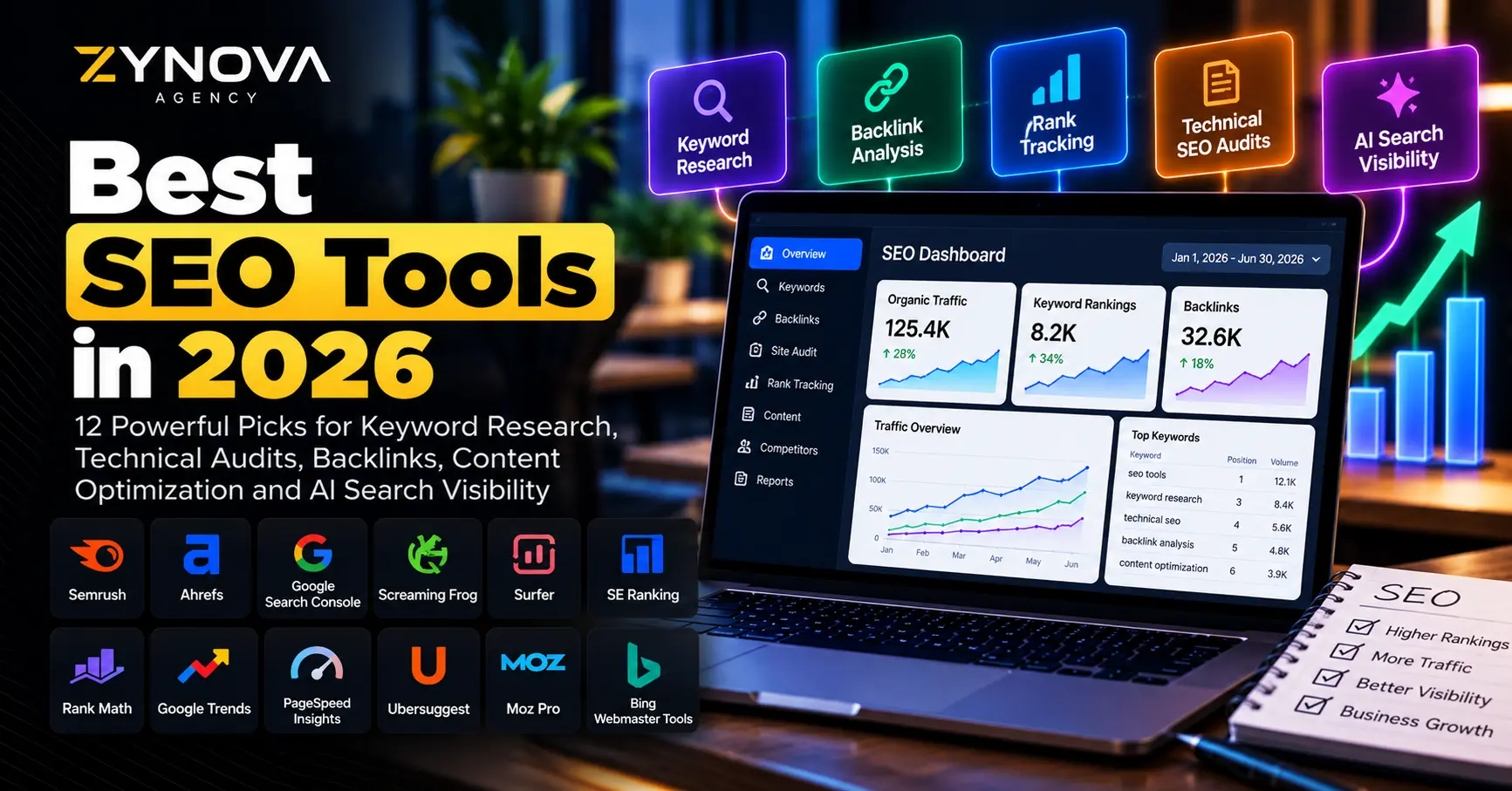
This guide compares 12 of the best SEO tools for keyword research, technical SEO, backlinks, content optimization, rank tracking and AI search visibility in 2026.
Best SEO Tools at a Glance
| SEO Tool | Best For | Main Strength |
|---|---|---|
| Semrush | All-in-one SEO | Keywords, competitors, audits, tracking and AI visibility |
| Ahrefs | Backlinks and research | Link data, competitor research and content opportunities |
| Google Search Console | First-party Google data | Indexing, clicks, impressions and queries |
| Screaming Frog | Technical SEO | Deep website crawling and diagnostics |
| Surfer | Content optimization | Search-focused content analysis |
| SE Ranking | Agencies and value | Rank tracking, audits and AI visibility |
| Rank Math | WordPress SEO | On-page optimization and schema |
| Google Trends | Topic research | Search-interest trends and seasonality |
| PageSpeed Insights | Performance | Core Web Vitals and performance diagnostics |
| Ubersuggest | Beginners | Keyword and competitor research |
| Moz Pro | SEO fundamentals | Keywords, links and site tracking |
| Bing Webmaster Tools | Bing visibility | Indexing, keywords and site diagnostics |
How We Chose the Best SEO Tools
The best SEO tools should provide information that helps you make better decisions.
A tool is not useful simply because it produces hundreds of charts.
It should help answer practical questions such as:
What are people searching for?
Which keywords are realistic opportunities?
Why are competitors ranking above us?
Which pages have technical problems?
Which websites link to competitors?
Which pages are losing traffic?
Is Google indexing the correct URLs?
How visible is the brand in AI-powered search?
No single platform answers every question equally well.
A professional SEO stack often combines first-party Google data with one research platform and one or two specialized tools.
1. Semrush — Best All-in-One SEO Platform
Semrush is one of the broadest platforms in this comparison.
Its SEO Toolkit currently combines keyword research, competitor analysis, technical audits, backlink research, content workflows and position tracking.
The platform’s official SEO documentation says it includes tools such as Keyword Magic, Site Audit, Position Tracking, Organic Research and Keyword Gap. Semrush has also expanded position tracking beyond traditional search to include ChatGPT and Google AI Mode.
This breadth makes Semrush useful for agencies and marketing teams that would rather work inside one large platform than combine several smaller products.
For keyword research, marketers can examine search volume, difficulty, intent, trends and competing pages.
For competitive research, Semrush can show which keywords competitors rank for and where content gaps exist.
Its Site Audit can also identify technical problems affecting crawlability, content and site health.
Another important 2026 development is AI visibility.
Semrush’s AI Visibility Toolkit can monitor brand mentions and citations across systems including ChatGPT, Google AI Overviews, AI Mode, Gemini and Perplexity.
That makes Semrush one of the best SEO tools for companies that want traditional SEO and AI-search monitoring inside the same ecosystem.
Best for: agencies, in-house SEO teams, competitor research and all-in-one SEO management.
2. Ahrefs — Best for Backlinks and Competitive Research
Ahrefs has long been associated with backlink research, but its platform now covers a much wider SEO workflow.
Its current core tools include Site Explorer, Keywords Explorer, Site Audit, Rank Tracker, GSC Insights, Content Explorer and Brand Radar.
Site Explorer is useful for investigating competitors.
You can examine organic keywords, pages attracting search traffic, referring domains and backlinks.
Keywords Explorer helps evaluate topics before investing time in content.
Content Explorer can help identify pages and topics that have already attracted links or organic visibility.
Ahrefs has also adapted heavily to AI-powered search.
Its current platform includes AI Mode Tracker, AI Overviews Tracker and an AI Visibility Checker alongside its traditional SEO tools.
That makes Ahrefs one of the best SEO tools when competitive research, links and content opportunities are major priorities.
For businesses building topic clusters and authority, backlink and competitor information can be particularly useful.
Best for: backlink analysis, keyword research, competitive SEO and content opportunities.
3. Google Search Console — Essential Free SEO Tool
Before paying for any SEO platform, connect Google Search Console.
Search Console provides information directly from Google about how your verified website performs in Search.
Google says its Search Console reports can show the queries bringing users to the site, along with impressions, clicks and position data. It can also be used to submit sitemaps, inspect URLs and monitor indexing.
This data is extremely valuable because third-party SEO platforms estimate many metrics.
Search Console shows what actually happened to your own website in Google Search.
For example, you can discover:
- Queries generating impressions
- Pages receiving clicks
- Changes in click-through rate
- Indexing problems
- Sitemap status
- Search positions
- URLs Google has discovered
It is also useful after publishing new content.
Suppose an article begins appearing for a keyword you did not originally target.
That can reveal a useful new section to add.
Search Console is therefore one of the best SEO tools for every website owner, regardless of budget.
If you’re building your SEO strategy from the beginning, also read Zynova’s guide to improving website SEO in 2026.
Best for: indexing, Google performance data, queries, clicks and technical monitoring.
4. Screaming Frog SEO Spider — Best for Technical SEO Audits
Screaming Frog approaches SEO differently from cloud-based keyword platforms.
SEO Spider is a desktop crawler.
It visits pages on a website in a similar way to a search crawler and collects information that can expose technical problems.
A technical crawl can help identify issues involving:
- Broken links
- Redirects
- Page titles
- Meta descriptions
- H1 headings
- Canonical URLs
- Internal linking
- Response codes
- Duplicate content
- Indexability
For small websites, many problems can be checked manually.
For websites with hundreds or thousands of pages, that becomes unrealistic.
A crawler lets the SEO team inspect the site systematically.
This makes Screaming Frog one of the best SEO tools for technical audits, migrations and large website reviews.
It is particularly valuable when a site has unexpected indexing problems, redirect chains or inconsistent metadata.
Best for: technical SEO specialists, site migrations, crawling and website diagnostics.
5. Surfer — Best for SEO Content Optimization
Surfer focuses heavily on content.
Its platform analyzes competing search results and provides recommendations designed to help writers cover topics more comprehensively.
This can include suggestions around:
- Related terms
- Content structure
- Topic coverage
- Headings
- Content gaps
- Article optimization
Surfer has also expanded beyond traditional Google optimization into AI visibility.
Its current positioning combines content optimization with broader organic and AI-search visibility.
This makes Surfer one of the best SEO tools for teams publishing large amounts of search-focused content.
However, optimization scores should remain guidance.
A page does not deserve to rank simply because it mentions every recommended phrase.
Original examples, expertise, usefulness and search intent still matter.
Use Surfer to identify gaps.
Do not use it to turn every article into mechanically optimized text.
Best for: SEO writers, content teams, agencies and on-page optimization.
6. SE Ranking — Best Value All-in-One Platform
SE Ranking combines many traditional SEO capabilities inside a platform often aimed at small businesses, agencies and growing teams.
Its current platform includes rank tracking, website audits, competitor analysis, backlink tools, keyword research and AI-search capabilities.
Rank tracking is one of its major use cases.
SEO teams can monitor target keywords over time rather than manually checking Google results.
That matters because rankings can vary by location, device and date.
SE Ranking has also invested in AI-search monitoring, reflecting the wider shift from pure Google ranking tools toward broader search visibility.
For agencies, reporting and multiple-project management can be particularly useful.
SE Ranking is one of the best SEO tools for businesses that need a broad toolkit but do not necessarily want to build their entire workflow around the largest enterprise platforms.
Best for: agencies, freelancers, rank tracking and growing SEO teams.
7. Rank Math — Best SEO Tool for WordPress
For WordPress websites, Rank Math can handle much of the page-level SEO workflow directly inside the editor.
It can help manage:
- SEO titles
- Meta descriptions
- Focus keywords
- Schema
- XML sitemaps
- Robots settings
- Canonical URLs
- Social metadata
- On-page checks
This makes it convenient because optimization happens in the same environment where the page is being published.
For example, Rank Math can warn when a focus keyword is missing from important page elements or when the article lacks internal and external links.
These checks are useful.
But the score should not become the objective.
A 100/100 Rank Math score does not guarantee rankings.
Likewise, a strong article can still perform well without satisfying every plugin recommendation.
Use the plugin as a checklist rather than as a replacement for SEO judgment.
For WordPress businesses, Rank Math can therefore be one of the best SEO tools for handling day-to-day on-page optimization.
Best for: WordPress websites, on-page SEO, schema and publishing workflows.
8. Google Trends — Best for Search Trends and Seasonality
SEO platforms estimate keyword demand, but Google Trends serves a different purpose.
It shows relative search interest over time.
This is useful when deciding whether a topic is:
- Growing
- Declining
- Seasonal
- Location-dependent
- Temporarily trending
Imagine comparing interest in several AI topics.
One phrase may have stable demand for years.
Another may suddenly grow because of a new product launch.
A third may spike temporarily and disappear.
That context helps marketers decide which content deserves long-term investment.
Google Trends should not replace normal keyword research because it does not provide the same data as Ahrefs or Semrush.
Instead, use it alongside other tools.
Among the best SEO tools, Google Trends is particularly helpful for validating whether market interest is changing.
Best for: trend research, seasonal keywords, topic validation and content planning.
9. PageSpeed Insights — Best for SEO Performance Diagnostics
Page performance affects user experience.
Google’s PageSpeed Insights helps analyze website performance using Lighthouse diagnostics and available field data.
It can help identify issues involving:
- Loading performance
- JavaScript
- Images
- Layout shifts
- Main-thread work
- Core Web Vitals
This is especially useful when a website looks fine visually but feels slow on real devices.
SEO teams should not obsess over achieving a perfect 100 score.
The objective is to identify genuine performance problems that affect visitors.
PageSpeed Insights is therefore one of the best SEO tools to keep in a free technical toolkit.
It becomes even more useful when combined with Search Console’s Core Web Vitals reporting and a crawler such as Screaming Frog.
Best for: Core Web Vitals, speed diagnostics and performance optimization.
10. Ubersuggest — Best for Beginner-Friendly Keyword Research
Ubersuggest provides keyword research and competitor information in a relatively approachable interface.
Its keyword tools can help users explore:
- Keyword ideas
- Search demand
- Related queries
- Competitor keywords
- Content opportunities
- Backlink information
This makes it useful for beginners who may find larger platforms overwhelming.
A small business owner might use Ubersuggest to generate ideas and examine competing pages before deciding whether a topic is worth pursuing.
It does not necessarily replace a larger platform for advanced agency work.
But not every business needs the largest possible dataset.
Ubersuggest earns a place among the best SEO tools for users who want a simpler entry point into keyword and competitor research.
Best for: beginners, small businesses and straightforward keyword research.
11. Moz Pro — Best for SEO Fundamentals and Link Metrics
Moz has been part of the SEO industry for many years.
Moz Pro combines keyword research, ranking information, site crawling and link analysis.
One of Moz’s most recognized concepts is Domain Authority, a third-party metric designed to estimate ranking strength.
Metrics like Domain Authority should not be confused with a Google ranking score.
Google does not use Moz’s DA directly.
However, comparative link metrics can still help SEOs understand competitors and evaluate websites during research.
Moz can be a useful platform for teams that want established SEO workflows without assembling many specialized products.
This makes it one of the best SEO tools for marketers focusing on traditional search fundamentals.
Best for: keyword research, links, rankings and general SEO monitoring.
12. Bing Webmaster Tools — Best Free Companion to Search Console
Google dominates many SEO discussions, but Bing should not be ignored.
Bing Webmaster Tools allows verified website owners to monitor how their sites appear within Microsoft’s search ecosystem.
It can help with:
- Indexing
- Search performance
- Sitemaps
- URL inspection
- Site diagnostics
Microsoft’s search ecosystem also matters beyond the standard Bing website because search technology can influence other products and AI-powered discovery experiences.
Bing Webmaster Tools should therefore be considered a companion to Search Console rather than a replacement.
Because it is free, there is little reason for serious websites to ignore it.
It is one of the best SEO tools for businesses that want broader visibility without another paid subscription.
Best for: Bing indexing, Microsoft search visibility and free technical monitoring.
Which SEO Tool Is Best for Keyword Research?
Ahrefs and Semrush are strong choices for detailed keyword research.
Both provide considerably more information than simply monthly search volume.
You can investigate:
- Search intent
- Keyword difficulty
- Related terms
- Competitors
- Ranking pages
- Search-result features
- Topic opportunities
Ubersuggest can be easier for beginners.
Google Trends is useful for validating how interest changes over time.
The strongest keyword workflow may therefore combine several tools.
For example:
Use Semrush or Ahrefs for keyword data.
Use Google Trends to check whether demand is rising.
Use Search Console after publication to see the real queries your page begins generating.
This is more useful than relying on one number from one platform.
Which SEO Tool Is Best for Technical SEO?
For deep crawling, Screaming Frog is one of the strongest options in this list.
Semrush and SE Ranking also provide cloud-based site audits.
Search Console is essential for understanding Google’s actual indexing status.
PageSpeed Insights adds performance diagnostics.
A strong technical stack could therefore include:
Search Console + Screaming Frog + PageSpeed Insights
That combination gives you first-party Google data, deep crawling and performance analysis without requiring several expensive subscriptions.
Which SEO Tool Is Best for Content?
Surfer specializes in content optimization.
Semrush also includes content-planning and optimization workflows.
Ahrefs helps identify competing content, keywords and content gaps.
For WordPress publishing, Rank Math provides useful on-page checks inside the editor.
No content tool should completely dictate what you write.
The objective is to understand the searcher’s problem and produce the most useful answer you can.
Tools should support that process.
They should not replace it.
Which SEO Tool Is Best for AI Search Visibility?
This category is changing quickly.
Traditional rank tracking asks:
Where does my page rank on Google?
AI visibility introduces additional questions:
Does ChatGPT mention my brand?
Does Google AI Mode cite my website?
Which sources are AI platforms using?
Which competitors appear more frequently in AI answers?
Semrush now combines traditional SEO tracking with AI search monitoring, while Ahrefs provides Brand Radar and several AI visibility tools.
SE Ranking and Surfer are also developing capabilities around AI-search visibility.
This area will likely continue changing rapidly throughout 2026.
Businesses should monitor it, but they should not abandon traditional SEO fundamentals.
Free SEO Tools vs Paid SEO Tools
A new website does not need an expensive SEO subscription immediately.
You can build a useful free stack with:
- Google Search Console
- Google Trends
- PageSpeed Insights
- Bing Webmaster Tools
- Free versions of selected keyword and audit tools
This can be enough to publish content, fix indexing problems and learn what users are searching for.
Paid SEO tools become more valuable when you need:
- Competitor research
- Large keyword datasets
- Backlink analysis
- Rank tracking
- Multiple websites
- Client reporting
- Content planning
- AI visibility tracking
Do not subscribe to several expensive platforms simply because professional SEOs use them.
Buy a tool when you can identify the workflow it will improve.
Avoid SEO Tool Overload
SEO software can become another form of procrastination.
A business may spend days comparing difficulty scores, content scores and competitor metrics without actually improving the website.
The best SEO tools should help you take action.
If Search Console shows an important page is not indexed, fix it.
If Screaming Frog finds broken internal links, repair them.
If Ahrefs reveals competitors have strong links to a useful resource, consider creating something genuinely better.
If Semrush reveals a relevant topic gap, investigate it.
If PageSpeed Insights exposes a serious performance problem, improve the page.
The tool is not the strategy.
The action you take from the data is what matters.
Build a Simple SEO Tool Stack
For many businesses, a simple setup is enough.
A practical stack could be:
First-party data: Google Search Console
Keyword and competitor research: Ahrefs or Semrush
Technical crawling: Screaming Frog
Content optimization: Surfer or Rank Math
Trend validation: Google Trends
Performance: PageSpeed Insights
That covers most important SEO activities without paying for several overlapping all-in-one platforms.
Businesses combining SEO with broader AI marketing can also read Zynova’s guide to the best AI marketing tools in 2026.
If you’re still building the SEO foundation itself, start with our guide on how to improve website SEO in 2026.
The Best SEO Tools Cannot Guarantee Rankings
This is important.
No SEO platform can guarantee the number-one position in Google.
SEO tools provide information, estimates and recommendations.
Actual search performance depends on many factors, including:
- Search intent
- Competition
- Content quality
- Website authority
- Links
- Technical accessibility
- User experience
- Brand strength
- Search-engine systems
Keyword difficulty scores are also estimates created by SEO companies.
Different tools can assign different difficulty numbers to the same keyword.
Use those metrics comparatively.
Do not treat them as guarantees.
The best SEO tools reduce uncertainty.
They do not eliminate it.
Which of the Best SEO Tools Should You Choose?
There is no universal winner among the best SEO tools.
Choose Semrush if you want a broad all-in-one SEO and AI-visibility platform.
Choose Ahrefs when backlinks, competitor research and content opportunities are major priorities.
Use Google Search Console on every website you control.
Choose Screaming Frog for deep technical crawling.
Choose Surfer for SEO-focused content optimization.
Choose SE Ranking for rank tracking and a broad agency-friendly platform.
Use Rank Math for WordPress on-page optimization.
Use Google Trends for demand and trend research.
Use PageSpeed Insights for performance diagnostics.
Choose Ubersuggest if you want a simpler keyword-research experience.
Consider Moz Pro for established SEO research workflows.
And connect Bing Webmaster Tools as a free complement to Search Console.
The right stack depends on the website, team and budget.
If your business needs help with technical SEO, content strategy, website optimization or organic growth, explore Zynova Agency’s SEO and digital growth services or contact Zynova Agency.
Frequently Asked Questions
What are the best SEO tools in 2026?
Some of the best SEO tools include Semrush, Ahrefs, Google Search Console, Screaming Frog, Surfer, SE Ranking, Rank Math, Google Trends, PageSpeed Insights, Ubersuggest, Moz Pro and Bing Webmaster Tools.
What is the best free SEO tool?
Google Search Console is one of the most important free SEO tools because it provides first-party information about your website’s performance and indexing in Google Search.
Which SEO tool is best for keyword research?
Ahrefs and Semrush are strong options for detailed keyword and competitor research. Ubersuggest can provide a simpler starting point for beginners.
Which SEO tool is best for backlinks?
Ahrefs is particularly well known for backlink and competitive-link research, while Semrush also provides extensive backlink analysis.
Which SEO tool is best for technical audits?
Screaming Frog is particularly useful for deep technical crawling. Semrush and SE Ranking also provide cloud-based site-audit functionality.
Which SEO tool is best for WordPress?
Rank Math is useful for managing WordPress on-page SEO, metadata, sitemaps, schema and publishing checks.
Do I need to pay for SEO tools?
Not necessarily. New websites can accomplish a significant amount using Google Search Console, Google Trends, PageSpeed Insights and Bing Webmaster Tools before purchasing more advanced software.
Can SEO tools guarantee Google rankings?
No. SEO tools provide data, estimates and recommendations. They cannot guarantee rankings because search results depend on competition, relevance, content, links, technical factors and search-engine systems.