
Best AI Marketing Tools: 12 Powerful Picks for 2026
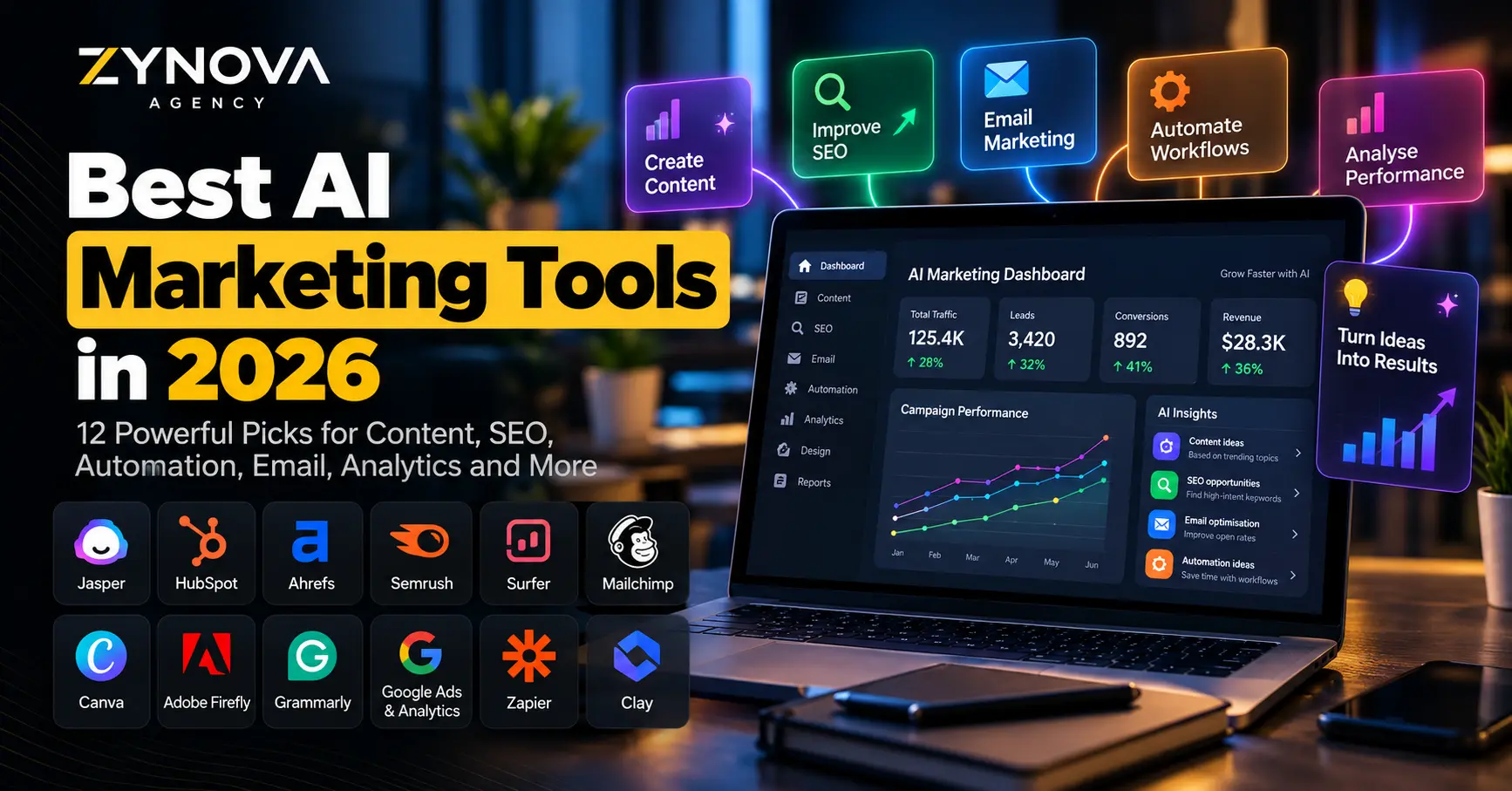
The best AI marketing tools in 2026 are no longer limited to writing social posts or generating quick blog drafts.
Modern marketing platforms can research audiences, create campaign assets, optimize content for search, track brand visibility in AI answers, personalize email campaigns, automate lead workflows, analyze performance and help teams produce content across multiple channels.
AI has also moved well beyond experimentation.
Jasper’s 2026 State of AI in Marketing research found that 91% of marketers actively use AI, up from 63% a year earlier. The same research found that marketing teams are increasingly focused on scaling AI through repeatable workflows, governance and measurable business outcomes rather than using isolated tools casually.
Canva’s 2026 marketing research shows a similar shift: AI is now standard inside creative teams, but quality, originality and consumer trust are becoming more important as AI-generated content increases.
That creates a new problem.
There are now hundreds of AI marketing products, and many of them overlap.
The best AI marketing tools are therefore not simply the platforms with the most features. They are the tools that solve a specific marketing problem and fit naturally into an existing workflow.
Here are 12 strong options for content, SEO, automation, email, design, analytics and AI-powered marketing operations in 2026.
Best AI Marketing Tools at a Glance
| Tool | Best For | Main Strength |
|---|---|---|
| Jasper | Marketing teams | Brand-governed content and campaign workflows |
| HubSpot Breeze | CRM marketing | AI inside marketing, sales and customer data |
| Ahrefs | SEO & AI visibility | Search, competitor and AI visibility intelligence |
| Semrush | Marketing intelligence | SEO, traffic, competitors and AI visibility |
| Surfer | SEO content | Content optimization for search and AI answers |
| Mailchimp | Email marketing | AI-assisted campaigns, analytics and automation |
| Canva AI | Creative marketing | Multi-channel designs and campaign assets |
| Adobe Firefly | Professional creative teams | Generative creative and marketing production |
| Grammarly | Brand communication | Writing quality, tone and brand consistency |
| Google Ads & Analytics AI | Paid marketing | Campaign optimization and performance insights |
| Zapier | Marketing automation | Connecting apps and automating workflows |
| Clay | GTM and lead generation | Data enrichment and personalized outbound workflows |
How We Chose the Best AI Marketing Tools
The best AI marketing tools should improve an actual marketing workflow.
A platform is more valuable when it saves time repeatedly, improves output quality, provides useful data or connects multiple stages of marketing.
We therefore considered:
- Content creation
- Brand consistency
- SEO
- AI search visibility
- Marketing automation
- Email marketing
- Paid advertising
- Analytics
- Creative production
- CRM integration
- Lead generation
- Workflow automation
Another important factor is specialization.
Ahrefs recently described AI marketing tools as a broad category containing very different types of software, from automation and AI visibility to content optimization and creative tools.
That is the right way to think about this market.
You usually do not need twelve AI platforms.
You need a small collection of tools where each one has a clear responsibility.
1. Jasper — Best AI Marketing Platform for Brand-Governed Content
Jasper is one of the most marketing-focused AI platforms available.
Instead of operating only as a general chatbot, Jasper is built around marketing content, campaigns, brand context, workflows and AI agents.
Its current platform combines marketing agents, content pipelines, brand voice, audience information, knowledge bases and governance inside one environment.
That makes Jasper particularly useful for larger marketing teams.
For example, a business can define brand rules once and then use them across articles, advertisements, email campaigns, product messaging and other marketing content.
Jasper’s agents can also handle tasks such as research, optimization and personalization while operating within that shared marketing context.
This is a major difference between a general AI assistant and a marketing-specific platform.
Jasper is one of the best AI marketing tools for organizations where many employees need to create content while maintaining a consistent voice.
Best for: marketing departments, agencies, brand governance, content operations and campaign production.
2. HubSpot Breeze — Best for AI Marketing Inside a CRM
HubSpot Breeze is most valuable when marketing already revolves around HubSpot.
Instead of separating AI from customer data, Breeze works inside the CRM environment.
HubSpot says Breeze Assistant can generate content, summarize records, prepare for meetings and complete tasks across HubSpot’s sales, marketing and service systems.
HubSpot has also expanded AI-assisted content generation across blog posts, pages, calls-to-action and knowledge-base content.
This connection to CRM context is important.
A standalone AI system may know how to write a marketing email.
Breeze can operate closer to the actual marketing database containing contacts, campaigns and customer information.
HubSpot’s 2026 product updates also continue moving toward a more agentic customer platform, with AI connected to demand generation, CRM context and marketing workflows.
For companies already using HubSpot, Breeze can be one of the best AI marketing tools because it reduces the need to move information between separate systems.
Best for: CRM marketing, campaign content, customer data, sales and marketing alignment.
3. Ahrefs — Best for SEO and AI Search Visibility
Ahrefs has expanded significantly beyond traditional keyword research.
It now combines SEO data with AI visibility tracking, competitive intelligence, content tools and AI-assisted analysis.
Its Brand Radar platform tracks whether brands appear in AI-generated answers across systems including ChatGPT, Gemini, Perplexity, Microsoft Copilot and Google’s AI search experiences.
Ahrefs says Brand Radar uses hundreds of millions of search-backed prompts to analyze mentions, citations and AI share of voice.
That is increasingly important because marketing visibility no longer exists only in traditional Google rankings.
Customers may discover a business through:
- Google Search
- AI Overviews
- AI Mode
- ChatGPT
- Perplexity
- Gemini
- YouTube
- TikTok
Ahrefs also continues to provide keyword research, competitor analysis, backlink analysis, site audits and content research.
This makes it one of the best AI marketing tools for marketers who want to understand both traditional search and emerging AI visibility.
If your company is building organic traffic, you may also want to read Zynova’s guide on how to improve website SEO in 2026.
Best for: SEO, competitor research, backlinks, content opportunities and AI visibility.
4. Semrush — Best for Broad Marketing and Competitive Intelligence
Semrush is another major platform for marketers who need data rather than only content generation.
It covers SEO, competitor intelligence, traffic analysis, keyword research, paid search and other digital-marketing activities.
In 2026, Semrush has continued adding AI-driven functionality and integrations, including AI-powered competitor traffic insights and connectors that bring marketing intelligence into AI workflows.
Semrush is particularly valuable when a marketer needs to understand what competitors are doing.
Instead of asking AI to guess which keywords or channels matter, marketers can work with actual search and traffic data.
That distinction is important.
AI can help interpret marketing information, but strong marketing decisions still depend on reliable underlying data.
Semrush is one of the best AI marketing tools for agencies and marketing departments managing multiple campaigns, competitors and channels.
Best for: SEO, competitor analysis, traffic intelligence, paid marketing and campaign research.
5. Surfer — Best for AI-Assisted SEO Content Optimization
Surfer focuses heavily on creating and improving content for search.
Its 2026 Content Editor workflow analyzes competitors, SERPs, NLP entities, brand information and content structure before helping users create or optimize a page.
Surfer has also expanded toward AI visibility rather than focusing exclusively on traditional rankings.
Its current platform combines content optimization with AI-search monitoring and recommendations designed to improve visibility in both search engines and AI answers.
This can be useful for teams producing large amounts of SEO content.
A writer can work from data-driven recommendations rather than guessing which related topics should appear in an article.
However, tools like Surfer should remain guidance systems.
A high optimization score does not automatically make an article useful.
The content still needs original information, strong examples and genuine value.
For companies already publishing SEO content, Surfer remains one of the best AI marketing tools for on-page optimization.
Best for: SEO articles, content briefs, content optimization and AI-search content strategy.
6. Mailchimp — Best for AI Email Marketing
Email remains one of the most useful owned marketing channels.
Mailchimp combines email campaigns, audience data, automation and increasingly AI-assisted analytics and content workflows.
Its 2026 product updates include Analytics AI as well as integrations that allow marketers to work with AI systems while creating email and SMS campaigns.
AI is particularly useful in email marketing because campaigns can contain many repetitive tasks.
Teams may need to:
- Write subject-line variations
- Segment audiences
- Analyze results
- Personalize messaging
- Create follow-ups
- Test campaign ideas
Automation can help reduce the manual workload around those processes.
Mailchimp is therefore one of the best AI marketing tools for small and medium-sized businesses that want email marketing and automation inside one established platform.
Best for: newsletters, email campaigns, audience segmentation and automated follow-ups.
7. Canva AI — Best for Everyday Marketing Creative
Marketing teams constantly need visual assets.
That may include:
- Instagram posts
- Advertisements
- Presentations
- Product graphics
- YouTube thumbnails
- Stories
- Reels
- Email graphics
- Campaign concepts
Canva’s AI capabilities are increasingly designed around producing multiple campaign assets from a single idea.
Canva AI 2.0 can start from a goal or campaign brief and generate coordinated content across different formats while keeping elements editable.
That is useful because marketing rarely requires only one image.
A product launch might need several social sizes, a presentation, an advertisement and additional branded content.
Canva’s 2026 marketing research also found extremely high AI adoption among marketing leaders, while emphasizing that human creativity and trust still matter.
For teams without a dedicated designer for every task, Canva remains one of the best AI marketing tools for fast everyday creative work.
Best for: social graphics, campaign creative, presentations, advertisements and brand content.
8. Adobe Firefly — Best for Professional AI Creative Production
Adobe Firefly targets more advanced creative workflows.
In 2026, Adobe expanded Firefly into a broader creative AI studio with agentic capabilities spanning ideation, creation and production.
Adobe has also introduced workflows that can help marketers create brand kits, short product videos, storyboards and other campaign assets.
The major advantage is integration.
Professional creative teams may already work inside Photoshop, Premiere Pro, Illustrator and other Adobe software.
Bringing AI into those environments can be more efficient than generating assets in one application and rebuilding them somewhere else.
Adobe has also positioned Firefly strongly around enterprise creative and marketing workflows.
For agencies, designers and larger marketing teams, Firefly is one of the best AI marketing tools when visual quality and professional editing matter.
Best for: agencies, designers, product campaigns, video and professional marketing production.
9. Grammarly — Best for Brand-Safe Marketing Writing
Marketing teams write constantly.
Even when AI generates the first draft, someone still needs to make sure the final copy is clear, consistent and appropriate for the brand.
Grammarly’s business offering combines AI writing assistance with organizational knowledge and brand-related controls.
That can be useful across:
- Marketing emails
- Landing pages
- Proposals
- Social posts
- Customer communication
- Internal campaigns
- Reports
Grammarly is not a complete marketing platform.
Its value comes from improving the quality of communication across many applications where employees already write.
That makes it one of the best AI marketing tools for organizations where brand tone and writing consistency matter across a large team.
Best for: editing, brand voice, clarity, tone and business communication.
10. Google Ads and Analytics AI — Best for Paid Marketing Insights
Google is adding more AI directly into its advertising and analytics products.
In August 2026, Google announced AI-powered summaries and additional agentic experiences across Google Ads and Google Analytics to help marketers understand performance and act on insights more quickly.
Google has also continued expanding AI Max for Search campaigns, giving advertisers additional AI-assisted targeting and creative capabilities.
This matters because paid advertising generates huge amounts of data.
Marketers need to understand:
- Which campaigns perform
- Which audiences convert
- Which search terms matter
- Where costs are increasing
- Which creative combinations work
- Where budgets should change
AI can help surface patterns without manually examining every report.
Google’s tools therefore remain among the best AI marketing tools for businesses already spending money on Google Ads.
Best for: paid search, campaign analysis, advertising optimization and performance reporting.
11. Zapier — Best for AI Marketing Automation
Many AI tools can generate an answer.
Zapier is useful because it can help turn that answer into an action.
For example, a marketing workflow could automatically:
- Receive a new lead.
- Analyze the inquiry with AI.
- Categorize the lead.
- Add it to a CRM.
- Notify the correct salesperson.
- Draft a personalized follow-up.
- Create a task.
- Update a reporting sheet.
Zapier’s 2026 AI automation platform connects thousands of applications and supports AI-powered workflows and agents.
Zapier also reported that, in an analysis of 10,000 AI-powered workflows, almost one-third were related to improving lead-management processes such as capture, enrichment, routing and follow-up.
This shows where AI marketing can become especially valuable.
The biggest productivity gains often come from connecting systems rather than asking employees to manually copy AI responses from one tool into another.
Zapier is therefore one of the best AI marketing tools for workflow automation.
Businesses needing more specialized systems can also explore Zynova’s AI automation services.
Best for: lead routing, marketing automation, CRM workflows and app integrations.
12. Clay — Best for AI-Powered GTM and Lead Research
Clay focuses on go-to-market workflows.
It combines business data, enrichment, research and automation to help teams identify and engage potential customers.
In 2026, Clay has been evolving toward what it describes as an end-to-end orchestration platform for go-to-market teams, with systems designed to learn from previous GTM activity and help teams decide what to do next.
This makes Clay particularly useful for B2B marketing and outbound campaigns.
A marketing or sales team might use it to:
- Find prospects
- Enrich company information
- Research accounts
- Segment leads
- Personalize outreach
- Trigger follow-up workflows
Clay is more specialized than a general marketing assistant.
That specialization is exactly why it can be valuable.
For B2B organizations, it can be one of the best AI marketing tools for combining prospect data with personalized outbound campaigns.
Best for: B2B marketing, lead generation, account research and outbound personalization.
Which of the Best AI Marketing Tools Should You Choose?
Do not begin by asking which product has the most AI features.
Start with the marketing problem.
If you need scalable branded content, Jasper may be appropriate.
If marketing already lives inside HubSpot, Breeze may provide more value.
If organic search and AI visibility are priorities, Ahrefs, Semrush or Surfer may be more relevant.
If email is central to your business, Mailchimp deserves consideration.
For visual production, Canva and Adobe Firefly solve different levels of creative complexity.
For paid advertising, Google’s own AI tools are directly connected to campaign data.
For automation, Zapier can connect the systems together.
For B2B prospecting, Clay offers more specialized workflows.
That is how the best AI marketing tools should be selected: based on the workflow they improve.
Build an AI Marketing Stack Instead of Buying Everything
AI tool overload is becoming a genuine problem.
A marketing team may subscribe to several writing tools, multiple SEO platforms, three design products and different automation services.
Each subscription may look inexpensive by itself.
Together they create cost, training requirements and duplicated functionality.
A stronger approach is to create a simple stack.
For example:
Research and SEO: Ahrefs or Semrush
Content: Jasper or another primary AI assistant
Creative: Canva or Adobe Firefly
Email: Mailchimp or your existing CRM
Automation: Zapier
You may not need separate tools for every task.
The best AI marketing tools should reduce complexity, not increase it.
AI Marketing Should Still Sound Human
One of the biggest risks of widespread AI adoption is generic content.
If thousands of companies use similar prompts with similar tools, marketing can begin to sound identical.
Canva’s 2026 research found that consumers often recognize AI-generated advertising because they feel something is missing, even though many consumers are comfortable with AI when the final result is useful and relevant.
That is an important lesson.
AI should increase a team’s capacity.
It should not eliminate originality.
Strong brands still need:
- Original ideas
- Human judgment
- Real customer knowledge
- Distinctive positioning
- Consistent voice
- Quality control
- Useful information
The marketing teams that benefit most from AI are likely to be those that combine automation with strong human direction.
Measure the Results, Not the Amount of AI
Using more AI does not automatically mean better marketing.
The correct question is:
What improved after we introduced this tool?
Possible measurements include:
- Time saved
- Cost per lead
- Conversion rate
- Organic traffic
- AI visibility
- Email revenue
- Campaign production speed
- Lead-response time
- Content output
- Customer acquisition cost
Jasper’s 2026 research found that proving ROI has actually become harder even as AI adoption has increased, because leadership increasingly expects measurable business results rather than simple productivity claims.
That means businesses should connect AI adoption to clear outcomes.
Do not keep a tool simply because the team enjoys using it.
Keep it because it creates value.
Connect AI Marketing Tools Into Real Workflows
The strongest marketing systems combine multiple stages.
Imagine a potential customer downloads a guide.
The lead enters your CRM.
AI analyzes the person’s company and interest.
The lead is segmented.
A personalized email is drafted.
The appropriate salesperson receives a notification.
The campaign result is recorded.
Analytics later show which leads converted.
That is a marketing system.
Using an AI tool to generate one email is only one small part of it.
Businesses that need custom connected workflows can use Zynova’s AI automation services or custom software development services when standard marketing platforms cannot handle the required process.
The Best AI Marketing Tools in 2026 Are Becoming More Specialized
The best AI marketing tools are moving away from simple content generation.
Platforms are becoming more specialized around:
- AI agents
- Marketing data
- AI search visibility
- CRM context
- Campaign automation
- Personalization
- Creative production
- Lead intelligence
- Workflow orchestration
That shift is useful.
Businesses no longer need AI simply because it can write.
They need AI that understands the work being done and can connect to the systems where that work happens.
The strongest marketing stack will therefore usually combine data, creative tools and automation rather than relying on a single platform for everything.
If you’re still evaluating general AI platforms before building your marketing stack, read Zynova’s comparison of the best AI tools for business in 2026.
Which AI Marketing Tool Is Best for Your Business?
There is no universal winner among the best AI marketing tools.
Choose Jasper for structured marketing content and brand governance.
Choose HubSpot Breeze when your marketing depends heavily on HubSpot CRM.
Choose Ahrefs for SEO and AI visibility.
Choose Semrush for broad digital-marketing intelligence.
Choose Surfer for SEO content optimization.
Choose Mailchimp for email marketing.
Choose Canva for fast everyday creative work.
Choose Adobe Firefly for professional AI-powered creative production.
Choose Grammarly for writing quality and brand consistency.
Use Google Ads and Analytics AI when paid search is a major acquisition channel.
Choose Zapier when marketing systems need to work together automatically.
Choose Clay for B2B lead research and outbound workflows.
The best choice is the tool that removes a real bottleneck from your marketing process.
If your business needs help building AI-powered marketing workflows rather than simply subscribing to another tool, you can contact Zynova Agency to discuss the process you want to automate.
Frequently Asked Questions
What are the best AI marketing tools in 2026?
Some of the best AI marketing tools include Jasper, HubSpot Breeze, Ahrefs, Semrush, Surfer, Mailchimp, Canva, Adobe Firefly, Grammarly, Google’s advertising AI, Zapier and Clay. Each is designed for a different part of the marketing workflow.
What is the best AI tool for content marketing?
Jasper is strongly focused on marketing content and brand governance, while Surfer focuses more heavily on SEO content optimization. Canva and Adobe Firefly are useful when content production also requires visual assets.
What is the best AI marketing tool for SEO?
Ahrefs, Semrush and Surfer are strong choices. Ahrefs and Semrush provide broad search and competitive intelligence, while Surfer focuses more heavily on optimizing individual content pieces.
What is the best AI marketing tool for automation?
Zapier is a strong choice for connecting marketing applications and building AI-powered workflows. Businesses with more specialized requirements may need custom integrations.
What is the best AI tool for email marketing?
Mailchimp provides email marketing, automation, analytics and increasingly AI-assisted features inside one platform. CRM-based systems such as HubSpot can also be strong choices when email campaigns depend heavily on customer data.
Can AI replace a marketing team?
AI can automate repetitive work, accelerate research and help teams produce more content, but marketing still requires positioning, customer understanding, creative judgment, strategy and accountability.
How many AI marketing tools should a business use?
There is no ideal number. Most businesses should begin with a small stack where every platform has a clear role. Adding overlapping tools without a defined workflow often increases costs without improving results.