Best AI Visibility Tools: 10 Powerful Picks for 2026
The best AI visibility tools in 2026 help answer a question traditional SEO software was never originally designed to answer:
What does AI say about your brand when potential customers ask for recommendations?
Search behavior is changing quickly.
People still use Google, but they also research products, companies and services through ChatGPT, Gemini, Perplexity, Google AI Overviews and AI Mode.
That has created a new measurement category around AI visibility, Generative Engine Optimization (GEO), Answer Engine Optimization (AEO) and LLM visibility.
The growth in search demand is significant. Ahrefs’ September 2026 research reports that searches for “AI visibility tools” are up 266% year over year, while “AI visibility tracker” is up 156% and “AI visibility” itself is up 145%.
Traditional rank tracking tells you whether a page ranks fifth or tenth in Google.
AI visibility tracking asks different questions:
Does ChatGPT mention your company?
Does Gemini recommend a competitor instead?
Which websites does Perplexity cite?
Which pages from your own site appear as sources?
What topics does AI associate with your brand?
And are those AI mentions actually producing traffic or conversions?
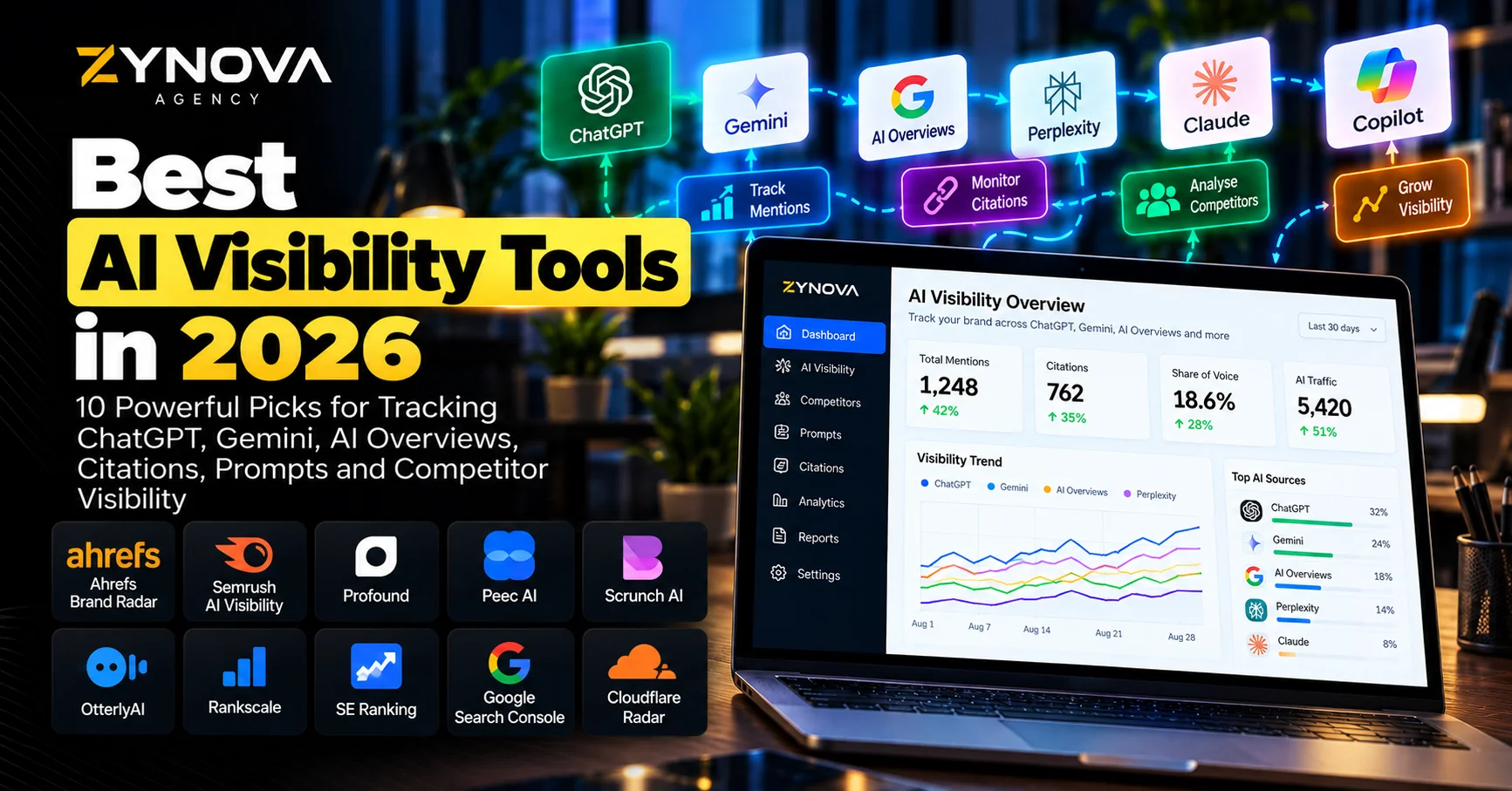
This guide compares 10 of the best AI visibility tools available in 2026 and explains what each platform is actually useful for.
Best AI Visibility Tools at a Glance
| Tool | Best For | Main Strength |
|---|---|---|
| Ahrefs Brand Radar | SEO + AI visibility | Massive search-backed prompt database and competitor analysis |
| Semrush AI Visibility Toolkit | All-in-one marketers | AI visibility combined with traditional SEO |
| Profound | Enterprise AI search | Deep AI search intelligence and agentic marketing |
| Peec AI | Marketing teams & agencies | Visibility, position, sentiment and citations |
| Scrunch AI | Enterprise AEO | Monitoring plus AI-site diagnostics |
| OtterlyAI | Accessible GEO monitoring | Prompt research, tracking and optimization |
| Rankscale | Multi-engine tracking | 17+ AI engines and technical GEO audits |
| SE Ranking AI Results Tracker | Existing SEO teams | AI visibility inside a broader SEO platform |
| Google Search Console | Google AI visibility | First-party AI Overview and AI Mode impressions |
| Cloudflare Radar AI Insights | AI crawler intelligence | AI bot, crawler and agent activity |
What Should an AI Visibility Tool Measure?
The best AI visibility tools should measure more than a single score.
Useful metrics include:
Brand mentions — how often your business appears in AI-generated answers.
Citations — whether the AI system links to your website as a source.
Share of voice — how often your brand appears compared with competitors.
Position — where your brand appears relative to other brands inside an AI answer.
Sentiment — whether AI describes your company positively, neutrally or negatively.
Prompt visibility — which questions trigger mentions of your brand.
Source influence — which websites AI systems rely on when answering questions about your market.
AI referral traffic — whether AI-generated citations actually send visitors to your website.
Crawler activity — whether AI bots can access and understand your website.
Not every tool measures all of these areas.
That is why choosing among the best AI visibility tools should begin with the information your business actually needs.
1. Ahrefs Brand Radar — Best for Combining AI Visibility With SEO Data
Ahrefs Brand Radar is one of the most comprehensive tools for businesses already serious about SEO.
It tracks brand mentions, citations, estimated impressions and AI share of voice across major AI search environments.
Ahrefs says Brand Radar’s AI Visibility Index now contains 456 million+ search-backed prompts across AI Overviews, AI Mode, ChatGPT, Gemini, Perplexity and Copilot. Custom prompts can also be monitored separately.
One of its biggest advantages is the connection with the wider Ahrefs ecosystem.
You can combine AI visibility with:
Keyword research.
Organic rankings.
Backlinks.
Search demand.
Technical SEO.
Web analytics.
AI bot activity.
Competitor research.
Ahrefs has also added AI traffic and bot-visit information to cited-page reporting, helping marketers see whether pages appearing in AI answers actually generate visits rather than simply earning citations.
This makes Brand Radar one of the best AI visibility tools for companies that want AI-search analysis without separating it completely from traditional SEO.
A business might discover that a competitor appears frequently in ChatGPT recommendations.
It can then investigate which pages and external sources are influencing those answers and compare that with traditional search performance.
That is much more actionable than simply knowing that the competitor was mentioned.
Best for: SEO teams, agencies, content marketers and businesses already using Ahrefs.
2. Semrush AI Visibility Toolkit — Best All-in-One Option for Marketing Teams
Semrush has also expanded aggressively into AI search measurement.
Its AI Visibility Toolkit tracks brands across ChatGPT, Gemini, Google AI Mode, AI Overviews and other AI discovery environments.
Semrush’s current AI visibility system includes:
AI Visibility Score.
Brand mentions.
Citations.
Competitor comparison.
Prompt research.
Sentiment.
Share of voice.
Daily custom prompt tracking.
AI-site auditing.
The platform says its broader prompt database contains more than 317 million prompts and responses, with data across ChatGPT, Gemini, Google AI Overviews and AI Mode.
Semrush also allows marketers to track selected prompts daily across AI systems and compare AI visibility with traditional Google positions.
This matters because AI search should not be measured in isolation.
Suppose your brand ranks well organically but rarely appears in AI answers.
That is a gap.
Alternatively, you may discover that your company receives substantial AI visibility even when traditional rankings are weaker.
Those comparisons can reveal opportunities traditional rank trackers cannot show.
Semrush is therefore one of the best AI visibility tools for marketing departments wanting SEO, competitor research and AI visibility within one ecosystem.
Best for: marketing teams, SEO agencies, competitors analysis and businesses already using Semrush.
3. Profound — Best for Enterprise AI Search Intelligence
Profound is built specifically around AI search and the changing way consumers discover brands through answer engines.
Its current platform covers ChatGPT, Perplexity, Claude, Gemini, Grok, Microsoft Copilot, DeepSeek and Google AI experiences.
Profound provides several layers of AI-search intelligence.
Its Answer Engine Insights can measure:
Visibility.
Share of voice.
Average position.
Sentiment.
Citations.
Competitive performance.
Its platform also includes prompt-volume analysis, agent analytics and AI marketing agents that can help move from measurement toward action.
That last part is important.
Many AI visibility tools tell you that you are losing.
Profound increasingly attempts to help marketers decide what to do next.
For example, the platform can identify citation gaps or content opportunities and use agentic workflows to help create or optimize material intended to improve AI-search performance.
Profound is one of the best AI visibility tools for larger companies where AI search is becoming a dedicated marketing channel rather than a small experiment.
It may be more platform than a small local company needs.
For enterprise brands, however, the depth of visibility and workflow functionality can make sense.
Best for: enterprise marketing, AEO teams, large brands and sophisticated AI-search programs.
4. Peec AI — Best for Clear AI Search Analytics
Peec AI focuses heavily on making AI-search analytics understandable for marketing teams.
Its platform tracks visibility, position, sentiment, share of voice and source citations across major AI platforms.
Peec currently monitors major environments including:
ChatGPT.
Google AI Overviews.
Google AI Mode.
Perplexity.
Gemini.
Microsoft Copilot.
Additional models can also be monitored depending on configuration and plan.
The platform is particularly useful for marketers that want to understand not just whether their company appears but how it appears.
For example, Peec can show:
How often the brand is mentioned.
Its average position.
Whether AI describes it positively.
Which competitors receive stronger visibility.
Which sources influence the answer.
Peec has also introduced AI referral tracking, allowing customers to connect analytics and examine sessions, engagement, conversions and revenue generated by AI assistants.
That is an important evolution.
A thousand AI mentions are not automatically valuable.
A smaller number of citations that generate real customers may matter considerably more.
Peec is one of the best AI visibility tools for teams wanting a focused, understandable platform rather than a complete traditional SEO suite.
Best for: in-house marketing teams, agencies, GEO reporting and AI referral analysis.
5. Scrunch AI — Best for Combining Visibility Monitoring With AI Site Readiness
Scrunch approaches AI visibility from both the external and technical sides.
The platform monitors what AI systems say about a brand while also examining how AI agents interact with the company’s website.
Its monitoring functionality includes:
Prompt tracking.
Brand performance.
Citations.
Competitors.
AI traffic.
Search trends.
Scrunch also offers site diagnostics designed to identify technical issues that may prevent AI systems from accessing or understanding content.
That makes it especially interesting for technical marketing teams.
Imagine your brand performs poorly in AI answers.
The problem may not only be content quality.
AI crawlers might be blocked.
Important content may depend heavily on JavaScript.
Pages may have poor response performance.
AI systems may struggle to identify key product details.
Scrunch attempts to connect those technical issues with AI visibility.
Its Agent Experience Platform also focuses on how AI agents consume website content as AI systems play a larger role in product research and buying journeys.
This makes Scrunch one of the best AI visibility tools for enterprise brands that want monitoring and technical AI-readiness analysis together.
Best for: enterprise websites, technical SEO teams, AEO programs and AI crawler diagnostics.
6. OtterlyAI — Best for Accessible AI Search Monitoring
OtterlyAI is a more focused AI-search monitoring and optimization platform.
It tracks brand mentions and citations across ChatGPT, Google AI Overviews, Google AI Mode, Perplexity, Gemini, Copilot and other AI systems.
Its platform combines several parts of the GEO workflow:
Prompt research.
AI visibility monitoring.
Competitor tracking.
Citation analysis.
Content audits.
Optimization recommendations.
OtterlyAI also lets marketers organize tracked prompts around areas such as branded, non-branded, top-of-funnel and bottom-of-funnel intent.
That is useful because not every prompt has the same business value.
Being mentioned for a broad educational question may be less valuable than appearing when someone asks:
“Which company is best for this service?”
or:
“What is the best software for this use case?”
The best AI visibility tools should help businesses prioritize high-intent questions rather than chasing mention counts for every possible prompt.
OtterlyAI’s combination of monitoring and content recommendations makes it attractive to agencies, smaller businesses and content teams that want a dedicated GEO platform.
Best for: small and medium businesses, agencies, prompt monitoring and content teams.
7. Rankscale — Best for Tracking Many AI Engines
Rankscale is designed specifically around AI visibility, AEO and GEO monitoring.
Its platform currently says it tracks more than 17 AI engines, including ChatGPT, Perplexity, Claude, Gemini, Google AI Overviews, AI Mode, Copilot and DeepSeek.
That broad engine coverage is its most obvious differentiator.
Some businesses may only care about ChatGPT and Google.
Others operate in industries or international markets where several AI systems matter.
Rankscale tracks:
Mentions.
Positions.
Citations.
Sentiment.
Competitor performance.
It also includes technical auditing with dozens of AI-oriented checks.
This means the platform can support both measurement and optimization work.
Rankscale is one of the best AI visibility tools for agencies and multi-brand SEO teams that want broad AI-engine coverage without tracking each platform manually.
Best for: agencies, international brands, multi-engine monitoring and technical GEO.
8. SE Ranking AI Results Tracker — Best for Existing SEO Workflows
SE Ranking has added AI visibility directly into its broader SEO platform.
Its AI Results Tracker currently covers:
Google AI Overviews.
Google AI Mode.
Gemini.
ChatGPT.
Perplexity.
The tool can measure brand mentions, links, competitors and the sources influencing AI-generated answers.
This is useful for SEO teams that do not necessarily want to purchase another completely separate platform.
A business already using SE Ranking for:
Keyword rankings.
Website audits.
Backlinks.
Competitor analysis.
SEO reporting.
can add AI monitoring into the same workflow.
That makes SE Ranking one of the best AI visibility tools for businesses that want AI tracking as an extension of traditional SEO rather than a standalone discipline.
It may not provide the same AI-specific depth as specialist platforms such as Profound or Peec.
But simplicity has value.
Not every company needs ten AI-search dashboards.
Best for: small agencies, existing SE Ranking users and businesses combining SEO with AI visibility.
9. Google Search Console — Best Free First-Party Tool for Google AI Visibility
Google Search Console is not a full multi-platform AI visibility tracker.
But in 2026 it became significantly more useful for AI-search measurement.
Google introduced dedicated Generative AI performance reporting for Search, covering AI Overviews and AI Mode, and states that the reporting was rolled out globally to websites by August 31, 2026.
The report can show:
AI-generated search impressions.
Pages receiving those impressions.
Device information.
Country information.
Performance trends over time.
The biggest advantage is obvious:
The information comes directly from Google.
Third-party AI tracking platforms must build their own measurement systems.
Search Console reports actual Google visibility for your own verified website.
However, its scope is limited.
It does not tell you how your brand performs in ChatGPT, Perplexity or Gemini.
It also cannot provide the same competitor intelligence available from specialized platforms.
That is why Search Console works best as a complement to the best AI visibility tools, not as a complete replacement.
For Zynova Agency specifically, Search Console should remain part of the core measurement stack because we are already using it for sitemap, indexing and SEO monitoring.
Best for: every website owner, Google AI Mode, AI Overviews and first-party Google data.
10. Cloudflare Radar AI Insights — Best Free Tool for AI Crawler Trends
Cloudflare Radar takes a very different approach.
It is not designed primarily to tell you whether ChatGPT recommends your brand.
Instead, its AI Insights section shows how AI bots and crawlers interact with the wider web.
The current dashboard includes information about:
AI bot traffic.
Crawler activity.
Crawl purpose.
Content types.
Response status codes.
AI crawler transparency.
Crawl-to-referral ratios.
AI agent standards.
Generative AI service popularity.
This can be useful for technical SEO and AI-search research.
For example, you can examine broader trends around AI crawlers and how the web is responding to them.
Cloudflare has also added agent-readiness information and visibility into how websites are adopting agent-facing standards.
Cloudflare Radar is therefore one of the best AI visibility tools to keep in a free research toolkit, but it solves a different problem from Ahrefs or Semrush.
Use it for technical and ecosystem intelligence.
Do not expect it to replace brand-level prompt tracking.
Best for: technical SEO, crawler research, AI bot monitoring and free market-level intelligence.
AI Visibility Tracking Is Different From Traditional Rank Tracking
Traditional SEO rank tracking is relatively straightforward.
You select a keyword.
The tool checks where your page appears.
AI search is more complicated.
An AI answer might mention five companies.
It might cite three websites.
The ordering may change.
The response may differ depending on location, personalization, wording or model.
One user may ask:
“Best CRM for small businesses.”
Another may ask:
“What CRM is easiest for a team of five people that uses Gmail?”
Those two prompts may produce very different recommendations.
This is why the best AI visibility tools focus increasingly on prompts, topics and share of voice rather than only a single ranking number.
AI-search measurement is probabilistic.
Treat visibility metrics as directional signals rather than perfect universal rankings.
Mentions and Citations Are Not the Same Thing
This distinction is extremely important.
An AI platform can mention your brand without linking to your website.
It can also cite your website without prominently recommending your brand.
These represent different types of visibility.
Imagine ChatGPT says:
“Popular options include Company A, Company B and Zynova.”
That is a brand mention.
Now imagine an AI Overview explains a technical concept and uses one of Zynova’s articles as a supporting source.
That is a citation.
Strong AI-search measurement should track both.
The best AI visibility tools increasingly separate brand presence from citation presence because each tells marketers something different.
AI Traffic Matters More Than Vanity Metrics
A company may appear in thousands of AI answers but receive very little business value.
This is becoming one of the most important lessons in AI-search measurement.
Ahrefs’ 2026 research notes growing demand for AI ROI reporting and highlights the shift from simply counting mentions toward asking whether citations produce traffic and conversions.
Peec has similarly added AI referral tracking that connects visibility with sessions, engagement, conversions and revenue.
That is the direction businesses should follow.
Track:
Visibility.
Then traffic.
Then leads.
Then revenue.
If AI visibility increases but business outcomes remain unchanged, investigate whether you are appearing for the right prompts.
Track High-Intent Prompts First
Do not begin with 5,000 random questions.
Start with questions connected to buying decisions.
For Zynova Agency, useful prompts might include:
“What is the best AI automation agency?”
“Who builds custom business software?”
“Best SaaS development company.”
“Best web development agency for a small business.”
“How can I automate my business workflows?”
These prompts are much more commercially meaningful than broad questions such as:
“What is artificial intelligence?”
A smaller set of high-intent prompts can provide better strategic information.
Once that baseline is established, expand gradually.
AI Visibility Still Depends on the Wider Web
You cannot optimize AI visibility only by editing your own website.
AI systems often rely on third-party sources.
These can include:
Industry publications.
Review platforms.
Reddit.
YouTube.
Wikipedia.
Directories.
News websites.
Comparison articles.
Partner websites.
This is why digital PR, brand mentions and external authority can influence AI visibility.
Ahrefs Brand Radar, Scrunch, Profound and Peec all place significant emphasis on understanding the sources behind AI answers, not only the final answer itself.
The broader web’s description of your company matters.
SEO and AI Visibility Should Work Together
AI visibility is not a replacement for SEO.
It is another discovery channel.
Traditional SEO helps your website become crawlable, authoritative and useful.
Those same assets can also influence AI-generated answers.
Businesses should therefore build one broader search strategy rather than creating isolated SEO and GEO departments that never communicate.
If your foundation still needs work, read Zynova’s guide to improve website SEO in 2026.
You can also compare the best SEO tools in 2026.
For wider marketing technology, see the best AI marketing tools in 2026.
Which AI Visibility Tool Should a Small Business Use?
A small business probably does not need an expensive enterprise AI-search platform immediately.
Start with Google Search Console because it is free.
Then consider a focused tracker such as OtterlyAI, SE Ranking or another affordable platform if AI visibility becomes strategically important.
Track a small set of high-value prompts.
Compare your brand with two or three real competitors.
Monitor mentions and citations over time.
Do not purchase enterprise software before you know what information you will actually use.
Which AI Visibility Tool Is Best for Agencies?
Agencies generally need:
Multiple projects.
Competitor benchmarking.
Client reporting.
Prompt tracking.
Multiple AI engines.
Exports.
Dashboards.
Historical trends.
Ahrefs Brand Radar, Semrush, Peec, Scrunch, Rankscale and Profound are particularly relevant depending on the agency’s size and service model.
Agencies should also consider reporting quality.
Clients need understandable insights.
A dashboard containing thousands of prompts has little value if the agency cannot explain what changed and what action should happen next.
Which AI Visibility Tool Is Best for Enterprise Brands?
Profound, Scrunch, Semrush, Ahrefs and Peec are all relevant for larger programs.
Enterprise teams may require:
Multiple markets.
Several brands.
Large prompt sets.
API access.
Custom reporting.
Governance.
Security controls.
Competitor benchmarking.
Integration with existing analytics infrastructure.
The best AI visibility tools for enterprise teams should fit into broader marketing operations rather than becoming isolated dashboards.
Build a Simple AI Visibility Stack
Most businesses do not need every tool in this article.
A practical setup might be:
Google AI data: Search Console.
AI brand visibility: Ahrefs Brand Radar or Semrush.
Specialist GEO analysis: Peec, Profound, Scrunch or OtterlyAI when deeper insight is required.
Technical crawler research: Cloudflare Radar plus your normal technical SEO tools.
That is enough for many companies.
Avoid software overload.
The objective is not to own the largest AI-search stack.
The objective is to know:
Where your brand appears.
Why it appears.
Where competitors are stronger.
What action should happen next.
And whether improved visibility creates business results.
Which of the Best AI Visibility Tools Should You Choose?
There is no universal winner among the best AI visibility tools.
Choose Ahrefs Brand Radar if you want AI visibility connected to powerful SEO and backlink data.
Choose Semrush AI Visibility Toolkit if you want AI search and traditional marketing intelligence in one ecosystem.
Choose Profound for a sophisticated enterprise AI-search program.
Choose Peec AI for focused visibility, position, sentiment and referral measurement.
Choose Scrunch AI when AI-site readiness and monitoring both matter.
Choose OtterlyAI for accessible GEO monitoring and optimization.
Choose Rankscale if broad multi-engine coverage is a priority.
Choose SE Ranking if you want AI results tracking inside an existing SEO workflow.
Use Google Search Console for first-party Google AI visibility.
Use Cloudflare Radar AI Insights for AI crawler and technical ecosystem intelligence.
The most important thing is to start measuring now.
AI search is developing quickly, and the baseline you collect today gives you something to compare against later.
If your business needs help improving traditional search visibility and preparing content for AI discovery, explore Zynova Agency’s SEO and Digital Growth services or contact Zynova Agency.
Frequently Asked Questions
What are the best AI visibility tools in 2026?
Some of the best AI visibility tools include Ahrefs Brand Radar, Semrush AI Visibility Toolkit, Profound, Peec AI, Scrunch AI, OtterlyAI, Rankscale and SE Ranking. Google Search Console and Cloudflare Radar also provide useful first-party or technical AI-search data.
What is an AI visibility tool?
An AI visibility tool tracks how a brand or website appears inside AI-generated answers. It can monitor mentions, citations, positions, sentiment, competitors, prompts and other signals across platforms such as ChatGPT, Gemini, Perplexity and Google AI Search.
Can I track whether ChatGPT mentions my business?
Yes. Several AI visibility platforms track ChatGPT mentions and citations, including Ahrefs, Semrush, Peec, OtterlyAI, Rankscale and Profound.
Can Google Search Console track AI Overviews?
Yes. Google’s dedicated Generative AI performance report now provides impression data for AI Overviews and AI Mode. Google says the reporting was rolled out worldwide by August 31, 2026.
What is the difference between SEO and GEO?
SEO focuses primarily on visibility in traditional search engines. GEO focuses on improving visibility and citations inside generative AI answers. The two overlap heavily because AI systems can use content and signals from the broader web and search ecosystem.
What metrics should I track for AI search?
Useful metrics include brand mentions, citations, share of voice, sentiment, average position, prompt visibility, competitor visibility, referral traffic and conversions.
Are AI visibility scores completely accurate?
No single tool can observe every possible AI response. Answers can change based on prompts, location, model updates and other factors. Use visibility scores as consistent benchmarking signals rather than absolute universal measurements.
Do small businesses need an AI visibility tool?
Not necessarily immediately. Start by monitoring Google Search Console and manually testing important high-intent prompts. Dedicated AI visibility software becomes more useful when AI discovery is generating meaningful brand exposure or when competitor monitoring is strategically important.