
Best Lead Generation Software: 10 Powerful Picks for 2026
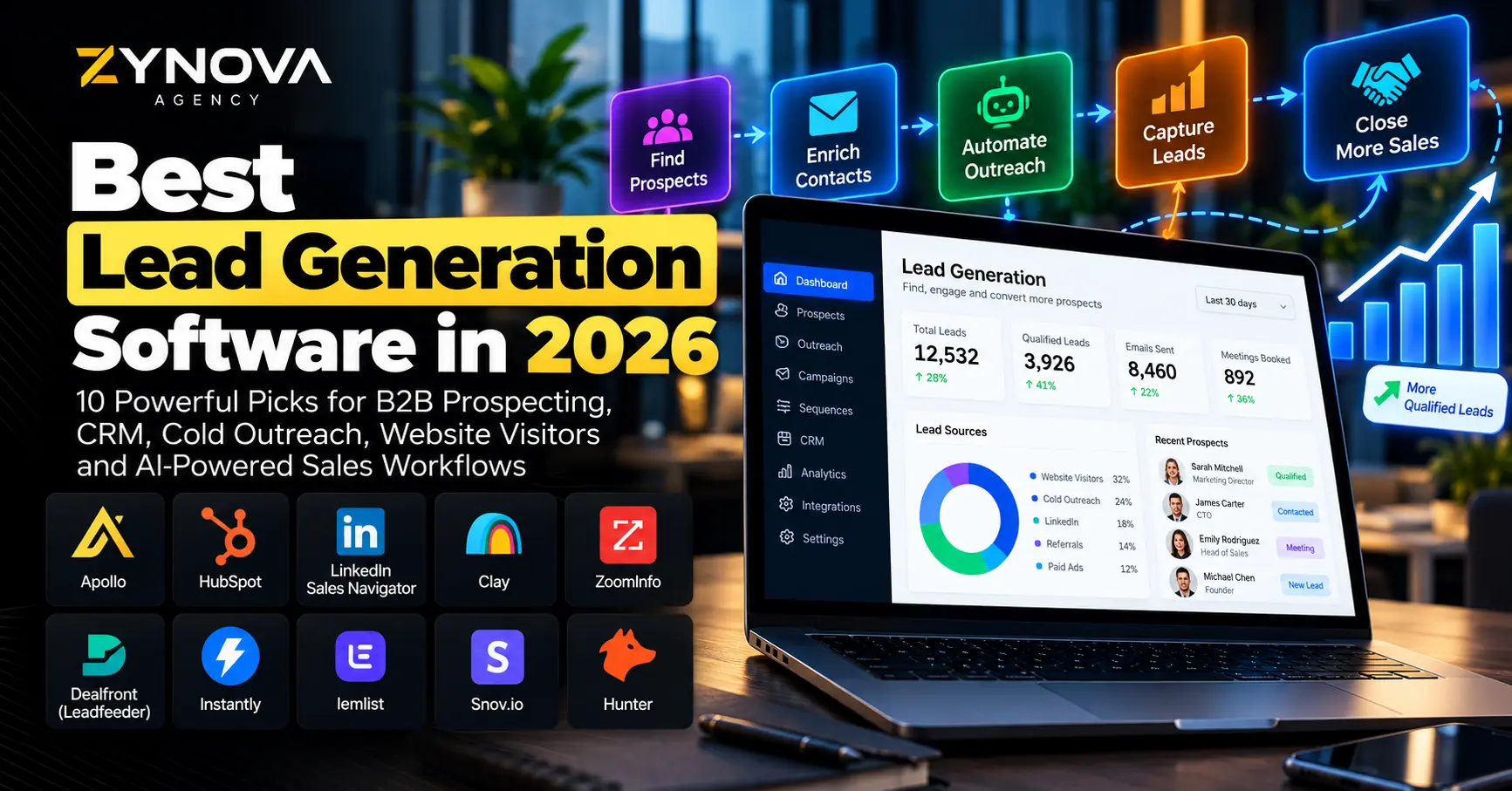
The best lead generation software in 2026 does much more than provide a list of names and email addresses.
Modern platforms can identify ideal prospects, detect buying signals, enrich contact records, qualify leads with AI, automate outreach, track website visitors and move qualified opportunities directly into a CRM.
That shift matters because B2B lead generation is becoming less about collecting as many contacts as possible and more about finding the right prospects at the right moment.
Apollo’s 2026 lead-generation research describes the modern process as a combination of contact discovery, enrichment, buying signals, qualification and workflow automation rather than simple list building. Clay similarly defines AI lead generation as using AI and automation to source, research, qualify and personalize outreach to new leads at scale.
The right tool depends heavily on your business model.
A B2B agency searching for company decision-makers needs something different from a business that wants to identify companies already visiting its website.
This guide compares 10 of the best lead generation software platforms for 2026.
Best Lead Generation Software at a Glance
| Platform | Best For | Main Strength |
|---|---|---|
| Apollo | All-in-one B2B prospecting | Contact data, signals, enrichment and outreach |
| HubSpot | Inbound lead generation | CRM, forms, marketing and lead nurturing |
| LinkedIn Sales Navigator | Professional prospecting | Decision-makers, filters and relationship signals |
| Clay | AI-powered lead research | Enrichment, intent signals and personalized workflows |
| ZoomInfo | Enterprise B2B intelligence | Large contact database and buying signals |
| Dealfront / Leadfeeder | Website visitor leads | Identifying companies already visiting your site |
| Instantly | Cold email lead generation | Lead finding, campaigns and AI sales agents |
| lemlist | Multichannel outreach | Email, LinkedIn, calls, SMS and WhatsApp |
| Snov.io | Lead finding + outreach | Email discovery, verification and campaigns |
| Hunter | Email prospecting | Finding and verifying professional emails |
How We Chose the Best Lead Generation Software
The best lead generation software should help businesses move from a potential prospect to a real sales opportunity.
We considered:
- Contact and company discovery
- Data accuracy
- Email verification
- Buying signals
- AI research
- Lead scoring
- CRM integration
- Outreach automation
- Website visitor identification
- Multichannel engagement
- Ease of use
- Scalability
The best system is not necessarily the platform with the largest database.
A smaller company may gain more value from software that fits its workflow than from millions of contacts it will never use.
1. Apollo — Best Overall B2B Lead Generation Platform
Apollo is one of the broadest options for B2B prospecting.
Its current platform combines prospect data, enrichment, buying signals, AI agents and outreach inside one connected system.
Apollo says its platform includes more than 240 million contacts and 30 million accounts, along with integrations, waterfall enrichment, buying signals and AI-powered prospecting.
Instead of using one tool to find contacts and another to send outreach, businesses can handle both stages inside Apollo.
Its AI systems can research accounts, build prospect lists, draft outreach and help automate prospecting workflows.
Apollo also supports signals such as:
- Job changes
- Website visits
- Buying intent
- Company activity
That makes it one of the best lead generation software platforms for B2B sales teams that want one system covering both research and execution.
Best for: SDR teams, agencies, founders, outbound sales and B2B prospecting.
2. HubSpot — Best for Inbound Lead Generation
HubSpot approaches lead generation from a different direction.
Instead of focusing mainly on cold prospecting, HubSpot is especially strong when leads come through your website, content, forms and marketing campaigns.
HubSpot Marketing Hub combines lead capture, marketing automation, CRM data and reporting inside the same platform. Its current product includes AI-powered lead-generation capabilities and omnichannel marketing automation.
A visitor might:
- Read a blog post.
- Complete a form.
- Enter the CRM.
- Receive an automated email sequence.
- Be scored or qualified.
- Move to a salesperson.
That entire journey can happen inside HubSpot.
HubSpot is therefore one of the best lead generation software options for businesses that depend heavily on inbound marketing rather than pure cold outreach.
Best for: inbound marketing, CRM, content marketing, forms and lead nurturing.
3. LinkedIn Sales Navigator — Best for Finding B2B Decision-Makers
LinkedIn Sales Navigator is especially valuable because it works directly with LinkedIn’s professional network.
Its current platform lets users search for prospects using dozens of filters including role, seniority, company, location and function.
LinkedIn says Sales Navigator provides access to advanced lead searching across more than one billion member profiles, along with lead alerts, buyer intent and CRM capabilities.
The main strength is context.
Instead of receiving only an email address, a sales representative can understand:
- Job title
- Company
- Work history
- Recent posts
- Shared connections
- Job changes
- Account activity
Sales Navigator can also save leads and alert users when important changes occur.
That makes it one of the best lead generation software platforms when relationship-based B2B selling matters.
Best for: B2B sales, professional services, enterprise prospecting and account-based selling.
4. Clay — Best for AI-Powered Lead Research and Enrichment
Clay is built around combining data, enrichment and AI research.
Its platform can connect information from more than 200 data providers, track intent signals and use AI agents to research companies and people.
Clay is particularly powerful when a business needs more than a simple contact database.
For example, you could start with a list of companies and automatically enrich each one with:
- Industry
- Employee count
- Funding
- Technology stack
- Decision-makers
- Contact information
- Recent events
- AI-generated account research
Clay can then use those details to help create personalized outreach.
Its 2026 guide describes AI lead generation as sourcing, researching, qualifying and personalizing leads automatically rather than simply purchasing a contact list.
That makes Clay one of the best lead generation software options for technically capable sales and growth teams.
Best for: enrichment, AI research, account-based marketing, RevOps and personalized outbound.
5. ZoomInfo — Best for Enterprise Sales Intelligence
ZoomInfo is focused heavily on enterprise B2B intelligence.
Its platform combines contact and company information with buyer intent, website visitor tracking, workflow automation and CRM enrichment.
ZoomInfo says its current system can help companies identify ideal buyers using firmographic, technographic and intent data while automatically routing and enriching leads.
The platform also includes AI-powered tools such as Copilot and GTM Studio.
These can help sales teams prioritize high-value accounts and detect events such as:
- Funding changes
- Executive moves
- Technology changes
- Buying intent
- Website activity
That makes ZoomInfo one of the best lead generation software platforms for larger companies with established sales teams.
The main drawback is that it can be more than a small business needs.
Best for: enterprises, sales intelligence, ABM, RevOps and large outbound teams.
6. Dealfront / Leadfeeder — Best for Website Visitor Lead Generation
Many companies already receive potential leads without realizing it.
A business might visit your pricing page, read several case studies and leave without filling out a contact form.
Dealfront’s Leadfeeder technology is designed to identify companies visiting a website.
Its tracker can analyze website activity and match anonymous business traffic with company information.
The platform can reveal:
- Which company visited
- Which pages they viewed
- How long they stayed
- Traffic source
- Engagement activity
- Relevant company information
Dealfront also uses buying signals and filtering to help prioritize accounts showing stronger intent.
This makes it one of the best lead generation software options for businesses already receiving meaningful website traffic.
Instead of generating entirely new demand, it helps identify existing interest.
If you’re working on attracting more qualified traffic first, Zynova’s guide to improving website SEO in 2026 can help strengthen that top-of-funnel activity.
Best for: B2B websites, inbound sales teams and website intent tracking.
7. Instantly — Best for Cold Email Lead Generation
Instantly is built around outbound email.
Its current platform can find leads, create campaigns, personalize outreach and use AI sales agents to automate parts of prospecting.
The platform combines:
- Lead finding
- Email outreach
- AI personalization
- Automated campaign workflows
- Reply handling
- Revenue tracking
Instantly also provides AI workflows that can react when a prospect visits a website, replies or books a meeting.
This makes it one of the best lead generation software platforms for agencies and teams running cold-email campaigns at scale.
The key consideration is deliverability.
Sending more emails does not automatically create more opportunities.
Strong targeting, verified addresses, relevant messaging and proper sending infrastructure still matter.
Best for: cold email, agencies, outbound campaigns and AI-assisted sales outreach.
8. lemlist — Best for Multichannel Prospecting
lemlist combines lead data with multichannel sales outreach.
Its platform can help users identify ICP-fit prospects and then contact them through email, LinkedIn, calls, WhatsApp and SMS.
lemlist currently includes a large lead database along with email verification and phone-number discovery.
Its value comes from connecting lead discovery and engagement.
A prospecting workflow could include:
- Find target accounts.
- Identify decision-makers.
- Verify contact information.
- Send a personalized email.
- Follow up on LinkedIn.
- Call the prospect.
- Track replies inside one sequence.
This makes lemlist one of the best lead generation software options for teams that do not want outreach limited to one channel.
Best for: multichannel outbound, agencies, SDR teams and personalized prospecting.
9. Snov.io — Best for Lead Discovery and Email Outreach
Snov.io combines lead generation, email discovery, verification and outreach.
Its current platform allows users to find prospects through a B2B database, enrich them with emails and phone numbers and then launch email and LinkedIn campaigns.
Snov.io also includes:
- Email finder
- Email verifier
- Data enrichment
- LinkedIn prospecting
- CRM functionality
- Deliverability tools
- Multichannel campaigns
This is useful for smaller teams that want prospect discovery and outreach in one platform.
A business can identify companies, find decision-makers, verify addresses and begin outreach without moving between several different systems.
That makes Snov.io one of the best lead generation software tools for practical B2B prospecting.
Best for: startups, sales teams, agencies and email prospecting.
10. Hunter — Best for Finding Professional Email Addresses
Hunter is more specialized than many of the platforms above.
Its strongest use case is finding and verifying business email addresses.
Hunter’s current platform can discover companies, search domains, find specific professional email addresses and verify contact data.
For example, if you know the company you want to contact, Hunter’s Domain Search can help identify relevant people associated with that organization.
Its Email Finder can then locate professional addresses for specific individuals.
Hunter also includes prospecting features, sequences and integrations, but its core strength remains email discovery and verification.
That makes it one of the best lead generation software options for businesses that already know which companies they want to target.
Best for: email finding, verification, targeted prospecting and small outbound teams.
Inbound vs Outbound Lead Generation Software
Not every lead-generation tool solves the same problem.
Inbound lead generation attracts people who are already researching a problem.
Examples include:
- SEO
- Blog content
- Landing pages
- Lead magnets
- Forms
- Webinars
HubSpot and Dealfront are especially useful here.
Outbound lead generation starts by identifying prospects and contacting them directly.
Examples include:
- Cold email
- LinkedIn outreach
- Cold calling
- Account-based selling
Apollo, LinkedIn Sales Navigator, Instantly, lemlist and Snov.io are stronger examples in this category.
Many companies use both.
Your SEO and content can attract inbound demand while sales teams use outbound tools to target companies that match the ideal customer profile.
If you’re building that wider marketing stack, see Zynova’s comparison of the best AI marketing tools in 2026.
AI Is Changing Lead Generation
AI is becoming increasingly important across the best lead generation software platforms.
Modern systems can now:
- Research prospects
- Enrich records
- Score leads
- Identify buying signals
- Summarize companies
- Personalize outreach
- Route opportunities
- Generate follow-ups
Clay’s AI lead-generation model focuses heavily on sourcing, researching, qualifying and personalizing prospects automatically.
Apollo is also moving toward agentic workflows where AI systems can build prospect lists, research accounts and assist with outreach.
This does not mean businesses should automate every interaction.
Good lead generation still depends on relevance.
AI should help teams research faster and personalize more effectively rather than simply send larger volumes of generic outreach.
Data Quality Matters More Than List Size
A database containing hundreds of millions of contacts sounds impressive.
But the number matters less if the records are outdated.
Bad lead data creates several problems:
- Bounced emails
- Wasted sales time
- Wrong job titles
- Duplicate CRM records
- Poor personalization
- Lower deliverability
That is why verification and enrichment are important.
Tools such as Apollo, Clay, ZoomInfo, Snov.io and Hunter all place significant emphasis on data accuracy or enrichment workflows.
The best lead generation software should help salespeople spend less time correcting information and more time speaking with relevant prospects.
Buying Signals Are Becoming More Important
Static lists answer:
Who could buy from us?
Buying signals help answer:
Who might be interested right now?
Signals can include:
- Website visits
- Funding events
- Job changes
- Hiring activity
- Technology adoption
- Content engagement
- Intent data
Apollo, ZoomInfo, Dealfront and LinkedIn Sales Navigator increasingly use these types of signals to help prioritize prospects.
This can significantly improve prospecting efficiency.
Instead of contacting every company in a market, sales teams can concentrate on the accounts showing relevant activity.
Lead Generation Should Connect to Your CRM
Finding a prospect is only the beginning.
The lead should eventually move into a structured sales process.
A good workflow might look like:
Lead discovered → enriched → qualified → added to CRM → assigned to rep → contacted → followed up → converted
Without CRM integration, leads often end up scattered across spreadsheets and separate applications.
This is why platforms such as HubSpot, Apollo, ZoomInfo and Sales Navigator place significant emphasis on CRM connectivity.
Businesses using multiple systems can also use automation to connect lead-generation tools to their existing sales workflows.
Zynova’s guide to the best AI automation tools in 2026 covers several platforms that can help connect these systems.
Do Not Automate Spam
Automation creates a temptation to maximize volume.
That is usually the wrong goal.
Sending thousands of irrelevant cold messages may damage:
- Brand reputation
- Email deliverability
- Domain reputation
- Response rates
- Customer trust
The best lead generation software should help you improve targeting, not simply send more messages.
Start with a clearly defined ideal customer profile.
Research why the prospect might need your service.
Personalize the message where it genuinely matters.
Give people an easy way to opt out.
And follow applicable privacy and marketing regulations for the locations where you operate.
Quality is usually more sustainable than volume.
Which Lead Generation Software Is Best for Small Businesses?
For a small B2B business, Apollo can provide a broad combination of lead data and outreach.
Hunter can be useful when you already know which companies you want to contact.
Snov.io provides a practical mix of prospecting, verification and email campaigns.
HubSpot is attractive when leads primarily come through the website.
The right choice depends on whether your main strategy is inbound or outbound.
Most small companies do not need five lead-generation tools.
Start with one primary platform and connect additional software only when there is a clear need.
Which Lead Generation Software Is Best for Agencies?
Agencies often need to research prospects and manage outbound campaigns efficiently.
Apollo, Clay, Instantly and lemlist are particularly relevant.
Apollo provides broad prospect data.
Clay helps enrich and research leads.
Instantly focuses strongly on cold email.
lemlist provides multichannel outreach.
An agency may combine two tools, but avoid building an unnecessarily complicated stack.
The best lead generation software should reduce operational work rather than create another layer of administration.
Which Lead Generation Software Is Best for Website Leads?
Dealfront is especially useful when you want to identify companies already visiting your website.
HubSpot can capture people who submit forms and then manage them through the CRM.
These two approaches solve slightly different problems.
Dealfront can identify company-level website activity even when someone does not complete a form.
HubSpot is stronger once a visitor intentionally becomes a known lead.
Businesses generating traffic through SEO should also make sure their website itself is optimized to convert that traffic into real opportunities.
Build a Simple Lead Generation Stack
For many B2B businesses, a simple stack could look like:
Prospect discovery: Apollo or LinkedIn Sales Navigator
Research and enrichment: Clay
Outbound: Instantly or lemlist
CRM: HubSpot
Website intent: Dealfront
You may not need every layer.
Choose only the tools that solve a real bottleneck.
The best stack is not the one with the most software.
It is the one your team actually uses consistently.
Which of the Best Lead Generation Software Should You Choose?
There is no universal winner among the best lead generation software platforms.
Choose Apollo for broad B2B prospecting and outreach.
Choose HubSpot for inbound lead generation and CRM workflows.
Choose LinkedIn Sales Navigator for identifying professional decision-makers.
Choose Clay for advanced enrichment and AI research.
Choose ZoomInfo for enterprise sales intelligence.
Choose Dealfront to identify companies visiting your website.
Choose Instantly for scaled cold email.
Choose lemlist for multichannel prospecting.
Choose Snov.io for lead finding, verification and outreach in one system.
Choose Hunter when professional email discovery is the main requirement.
The strongest lead-generation strategy starts with the customer profile, not the tool.
If your business needs a custom lead-generation workflow, CRM integration or AI-powered outreach system, explore Zynova Agency’s AI automation services or contact Zynova Agency to discuss the workflow you want to build.
Frequently Asked Questions
What is the best lead generation software in 2026?
Some of the best lead generation software platforms include Apollo, HubSpot, LinkedIn Sales Navigator, Clay, ZoomInfo, Dealfront, Instantly, lemlist, Snov.io and Hunter.
What is the best lead generation software for small businesses?
Apollo, Snov.io and Hunter can be practical options for smaller B2B companies, while HubSpot is a strong choice for inbound lead generation and CRM-based workflows.
What is the best B2B lead generation tool?
Apollo, LinkedIn Sales Navigator, Clay and ZoomInfo are strong B2B options. The right platform depends on whether you need contact data, professional-network research, enrichment or enterprise buying signals.
What is the best lead generation software for cold email?
Instantly, lemlist and Snov.io are designed heavily around outbound email workflows. Apollo also combines contact discovery with outreach.
What is the best tool for finding business email addresses?
Hunter specializes in professional email discovery and verification. Apollo, Snov.io and lemlist also provide contact-data capabilities.
What is the best lead generation software for website visitors?
Dealfront’s Leadfeeder technology is specifically designed to identify companies visiting a website and reveal engagement activity.
Can AI generate leads automatically?
AI can help discover, research, qualify and prioritize leads while also supporting personalized outreach. However, businesses still need a strong ideal customer profile, good data and human oversight for important sales decisions.
Is lead generation software worth it?
It can be valuable when it reduces manual prospecting, improves data quality and helps sales teams focus on relevant opportunities. It is less useful when a business buys software without a clear sales process.