
Best Email Marketing Platforms: 10 Powerful Picks for 2026
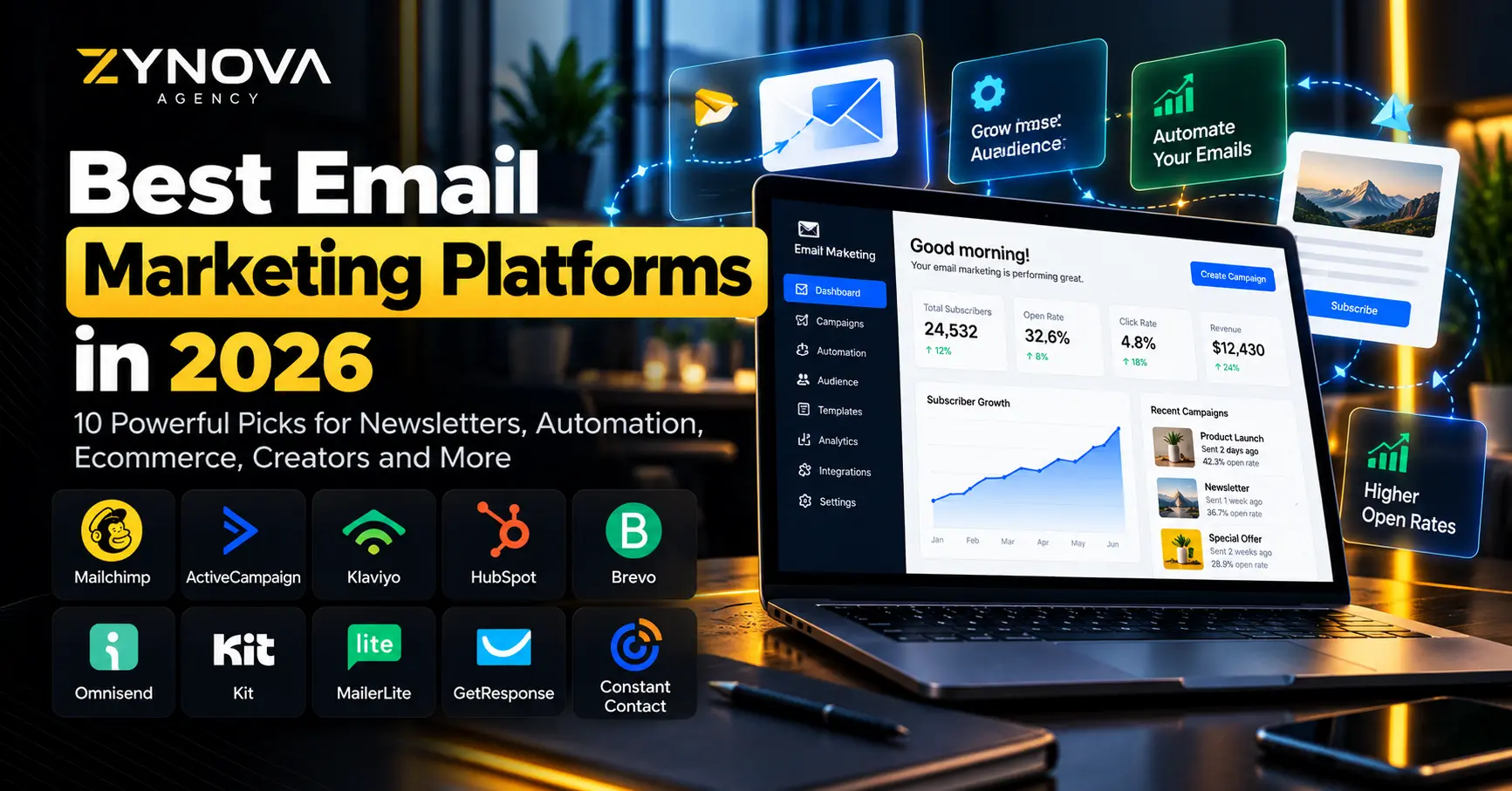
The best email marketing platforms in 2026 do much more than send newsletters.
Modern platforms can segment subscribers, build automated customer journeys, personalize messages, recover abandoned carts, connect with CRM data, analyze campaign performance and increasingly use AI to help marketers create and optimize campaigns.
Email also remains valuable because it is an owned channel.
Unlike a social-media audience, an email list gives businesses a direct way to communicate with people who have chosen to hear from them. For ecommerce brands, email can also help businesses collect and use first-party customer data for personalization and lifecycle marketing.
The challenge is choosing the right platform.
A creator sending a weekly newsletter does not need the same system as an ecommerce store with thousands of products. A company using HubSpot CRM has different requirements from a small local business that only needs a simple monthly newsletter.
That is why the best email marketing platforms should be compared by use case rather than by the size of their feature lists.
Here are 10 strong options for 2026.
Best Email Marketing Platforms at a Glance
| Platform | Best For | Main Strength |
|---|---|---|
| Mailchimp | Small and growing businesses | Email, automation and AI-assisted marketing |
| ActiveCampaign | Advanced automation | Deep behavioral workflows |
| Klaviyo | Ecommerce | Customer data and lifecycle automation |
| HubSpot | CRM-driven marketing | Email connected directly to CRM |
| Brevo | Multichannel small business marketing | Email, SMS and automation |
| Omnisend | Ecommerce automation | Store-focused email, SMS and push |
| Kit | Creators | Newsletters, automation and creator monetization |
| MailerLite | Simplicity and value | Easy email campaigns and automation |
| GetResponse | Funnels and lifecycle marketing | Email, automation and landing pages |
| Constant Contact | Beginners and local businesses | Easy email and SMS automation |
How We Chose the Best Email Marketing Platforms
The best email marketing platforms should support more than attractive email templates.
A useful platform should help businesses manage the complete subscriber journey.
We considered:
- Email campaign creation
- Automation
- Segmentation
- Personalization
- Ecommerce support
- CRM integration
- AI capabilities
- Reporting
- Landing pages and forms
- Ease of use
- Scalability
Automation is particularly important.
A basic newsletter may be sent manually, but high-value email programs increasingly use behavior-based workflows.
Examples include welcome sequences, abandoned-cart messages, post-purchase emails, lead nurturing and re-engagement campaigns.
HubSpot’s 2026 guidance similarly describes modern email marketing automation platforms as systems for personalized workflows, segmentation, customer data and behavioral targeting rather than simple email-sending tools.
1. Mailchimp — Best for Small and Growing Businesses
Mailchimp remains one of the most recognizable names in email marketing.
It combines campaign creation, subscriber management, automations, analytics and integrations inside a relatively accessible platform.
Mailchimp has continued adding AI features in 2026.
Its latest product updates include Analytics AI, expanded website tracking and connectors that allow marketers to work with campaign creation through AI tools such as ChatGPT and Claude.
That makes Mailchimp useful for businesses that want a familiar email platform while gradually adopting more advanced automation and AI.
A small business could begin with newsletters and simple customer campaigns, then introduce automated journeys and deeper analytics as the list grows.
Among the best email marketing platforms, Mailchimp is particularly practical for businesses that want broad functionality without starting with an enterprise-focused marketing system.
Best for: small businesses, newsletters, basic automation and growing marketing teams.
2. ActiveCampaign — Best for Advanced Email Automation
ActiveCampaign is particularly strong when automation is more important than simply sending broadcasts.
Its automation builder can create workflows that respond to subscriber behavior and marketing events.
ActiveCampaign describes automations as workflows that can run without continuous manual input once they have been configured.
The platform is useful for businesses that want to create longer customer journeys.
For example, a lead could enter a workflow after downloading a guide.
The system could wait, check whether the person opened an email, send a different message based on engagement, update contact information and eventually route a qualified lead toward sales.
That depth makes ActiveCampaign one of the best email marketing platforms for businesses where automation is a central part of lead nurturing.
ActiveCampaign’s own 2026 comparison guide also emphasizes that different platforms may advertise “automation” while offering very different levels of workflow sophistication.
Best for: advanced automations, lead nurturing, behavior-based campaigns and growing businesses.
3. Klaviyo — Best for Ecommerce Email Marketing
Klaviyo is heavily focused on ecommerce and B2C customer relationships.
Its strength comes from combining email automation with customer and purchase data.
Klaviyo can use behavior such as signups, purchases, browsing and cart activity to trigger personalized flows. Its current platform also extends beyond email into SMS, RCS, WhatsApp and mobile push.
This is particularly useful for online stores.
A normal newsletter platform might know a customer’s email address.
Klaviyo can work much more closely with commerce activity.
That enables flows such as:
- Welcome series
- Browse abandonment
- Cart abandonment
- Post-purchase follow-ups
- Product recommendations
- Win-back campaigns
Klaviyo published updated 2026 guidance describing these types of lifecycle automations as core ecommerce email workflows.
That makes Klaviyo one of the best email marketing platforms when ecommerce revenue and customer lifecycle automation are the main priorities.
Best for: Shopify stores, ecommerce, customer lifecycle marketing and personalized retention campaigns.
4. HubSpot — Best for CRM-Driven Email Marketing
HubSpot is strongest when email marketing needs to work directly with sales and CRM information.
Instead of keeping customer data in one system and email campaigns somewhere else, HubSpot allows marketing communication to operate within the same broader customer platform.
HubSpot supports both normal marketing emails and automated emails used inside workflows.
For example, a business could create different email journeys depending on:
- Form submissions
- Contact properties
- Company information
- Sales activity
- Lead lifecycle stage
- Previous engagement
HubSpot also supports simple workflow actions on lower marketing tiers and deeper automation on higher plans.
This makes HubSpot one of the best email marketing platforms for organizations where marketing and sales need to share the same customer information.
The trade-off is that HubSpot can become more complex and expensive as a business requires more advanced CRM and marketing functionality.
Best for: B2B businesses, CRM marketing, sales alignment and lead nurturing.
5. Brevo — Best for Multichannel Small Business Marketing
Brevo combines email marketing with automation and additional communication channels.
Its automation system can use emails, SMS, website tracking and other triggers to create customer journeys. Brevo also provides an AI-powered assistant called Aura for creating automations.
A business could use Brevo for a welcome sequence, purchase follow-up or abandoned-cart workflow.
The platform’s automation editor supports triggered email steps based on events defined by the marketer.
Brevo is particularly attractive when a small business wants more than email but does not necessarily need a large enterprise CRM.
That can make it suitable for ecommerce stores, service businesses and teams that want email and SMS in the same broader workflow.
Among the best email marketing platforms, Brevo provides a useful balance between multichannel functionality and accessibility.
Best for: small businesses, email and SMS marketing, transactional communication and automation.
6. Omnisend — Best for Ecommerce Automation
Omnisend is built specifically around ecommerce marketing.
The platform combines email campaigns, SMS, web push, audience segmentation and automated workflows around store activity.
Its automation system can respond to actions such as:
- New subscriptions
- Abandoned carts
- Browse abandonment
- Purchases
- Post-purchase events
Omnisend currently provides more than 15 pre-built automation workflow types that businesses can customize rather than building every journey from scratch.
It also integrates with common commerce platforms including Shopify, WooCommerce, BigCommerce, Wix and others.
That makes Omnisend one of the best email marketing platforms for ecommerce brands that want email, SMS and store-triggered automation in one focused system.
It is less relevant for a company that does not sell products online.
Best for: ecommerce stores, cart recovery, lifecycle automation and omnichannel customer messaging.
7. Kit — Best Email Marketing Platform for Creators
Kit, formerly known as ConvertKit, is built specifically around creators.
Its platform emphasizes newsletters, subscriber management, landing pages, automation and monetization rather than traditional corporate marketing.
Kit’s Visual Automations allow creators to build subscriber journeys based on clicks, purchases and engagement.
A creator could use Kit to:
- Deliver a lead magnet
- Send a welcome sequence
- Launch a course
- Run an evergreen newsletter
- Segment subscribers
- Sell digital products
- Publish a newsletter archive
Kit also distinguishes normal broadcasts from automated email sequences. A broadcast is a one-time newsletter, while a sequence automatically sends messages according to predefined timing.
That focus makes Kit one of the best email marketing platforms for bloggers, newsletter writers, educators and digital creators.
A large ecommerce store may prefer Klaviyo or Omnisend, but a creator selling courses or digital content may find Kit more natural.
Best for: creators, newsletters, courses, digital products and audience monetization.
8. MailerLite — Best for Simplicity and Value
MailerLite focuses heavily on keeping email marketing accessible.
Its automation builder can create triggered campaigns based on subscriber or ecommerce activity without requiring an advanced technical setup.
MailerLite supports triggers around activities such as cart abandonment, product purchases and subscriber behavior.
The platform is a good fit for businesses that want newsletters, forms, landing pages and automation without the complexity of a larger CRM system.
This can be especially useful for:
- Freelancers
- Small companies
- Bloggers
- Early-stage businesses
- Simple ecommerce stores
MailerLite is one of the best email marketing platforms when ease of use and straightforward automation matter more than deep enterprise functionality.
A business can begin with simple broadcasts and later introduce automated welcome sequences, purchase follow-ups and segmentation.
Best for: beginners, small businesses, bloggers and straightforward email automation.
9. GetResponse — Best for Funnels and Lifecycle Marketing
GetResponse combines email marketing with automation, landing pages, SMS and other lifecycle-marketing tools.
Its marketing automation builder can use customer behavior, conditions, filters and contact data to create personalized journeys.
GetResponse has also expanded its AI features.
Its AI Campaigns feature can generate a landing page, autoresponder and newsletter from a relatively small amount of campaign information.
The broader platform now positions itself around lifecycle automation, including promotional, triggered and repeat-purchase communication.
This combination makes GetResponse one of the best email marketing platforms for businesses that want to connect email with landing pages and automated campaign funnels.
Best for: funnels, lead nurturing, lifecycle marketing, landing pages and online campaigns.
10. Constant Contact — Best for Beginners and Local Businesses
Constant Contact focuses heavily on accessible marketing for smaller organizations.
Its automation tools support email and SMS sequences as well as common workflows such as welcome campaigns, abandoned carts, birthday messages and follow-ups.
The platform can also automatically resend emails to non-openers and create segments based on behavior such as clicks, purchases or event attendance.
That is useful for businesses that want practical automation without building complicated customer journeys.
Examples include:
- Restaurants
- Local service companies
- Associations
- Events
- Small retailers
- Community organizations
Constant Contact earns its place among the best email marketing platforms because many businesses need something straightforward rather than a highly technical marketing stack.
Best for: local businesses, beginners, simple newsletters, events and basic automation.
Which Email Marketing Platform Is Best for Ecommerce?
For ecommerce, Klaviyo and Omnisend stand out because their workflows are deeply connected to shopping behavior.
Both can use purchase, browsing and cart activity to trigger customer communication.
Klaviyo is particularly strong when detailed customer profiles, segmentation and broader B2C CRM functionality matter.
Omnisend is attractive when businesses want an ecommerce-focused system combining email, SMS and push notifications.
Mailchimp, ActiveCampaign and GetResponse can also support ecommerce use cases.
The right choice depends on how sophisticated your lifecycle marketing needs to become.
Among the best email marketing platforms, ecommerce businesses should pay particular attention to the quality of store integrations rather than simply comparing email templates.
Which Platform Is Best for Creators?
Kit is the most creator-focused option in this comparison.
Its product structure is designed around newsletters, subscriber relationships, digital products and creator monetization.
MailerLite can also be a strong choice for creators who want simpler and potentially more general email functionality.
GetResponse becomes useful when the business also needs landing pages, campaigns and funnels.
The best email marketing platforms for creators should make it easy to own and communicate with an audience without depending entirely on social algorithms.
Which Platform Is Best for B2B Marketing?
HubSpot and ActiveCampaign are strong choices for B2B workflows.
HubSpot becomes particularly valuable when marketing data needs to connect directly with CRM and sales activity.
ActiveCampaign can be attractive when sophisticated behavior-based automation is the main requirement.
Brevo can also work well for smaller B2B businesses that need email, SMS and transactional messaging.
If your wider strategy also includes AI-assisted content, SEO and marketing automation, see Zynova’s guide to the best AI marketing tools in 2026.
Email Automation Matters More Than Sending More Emails
A business does not improve email marketing simply by increasing send volume.
Better results usually come from sending more relevant messages.
Consider these two approaches.
The first business sends the same promotional email to every subscriber.
The second business sends different messages depending on whether someone is a new subscriber, active customer, cart abandoner or inactive customer.
The second approach uses customer context.
That is where the best email marketing platforms become much more valuable.
Automation can respond to behavior continuously without requiring an employee to manually send every message.
A properly designed workflow could:
- Welcome a subscriber.
- Deliver useful content.
- Identify engagement.
- Present an appropriate offer.
- Stop promotional messages after a purchase.
- Begin a customer onboarding sequence.
- Later request feedback or recommend another product.
This is much more useful than simply scheduling weekly newsletters.
Email Deliverability Should Influence Your Decision
An attractive campaign has little value if subscribers never receive it.
Deliverability depends on more than the software provider.
Businesses should also configure their sending domains correctly, maintain healthy subscriber lists, avoid spammy acquisition practices and monitor engagement.
Modern email systems commonly use authentication technologies such as SPF, DKIM and DMARC to help receiving mail providers verify legitimate senders.
The best email marketing platforms provide the tools and guidance needed to configure reliable sending, but businesses still need to follow good practices.
Do not purchase email lists.
Do not keep sending indefinitely to people who never engage.
Make unsubscribing easy.
Send content people actually requested.
Long-term list quality matters more than artificially increasing subscriber numbers.
Do Not Choose a Platform Only by Price
Pricing matters, but cheap software can become expensive if it creates operational problems.
Before selecting a platform, consider:
- Number of contacts
- Monthly email volume
- Automation limits
- Number of users
- SMS costs
- Ecommerce functionality
- CRM requirements
- Reporting
- Landing pages
- AI features
- Integrations
- Migration costs
Some platforms become significantly more expensive as contact counts increase.
Others include features at lower tiers that competitors reserve for premium plans.
The best email marketing platforms should therefore be evaluated against your expected growth, not only today’s subscriber count.
Email Marketing Should Connect to the Rest of Your Business
Email works best when it is not isolated.
A customer might first discover your business through SEO.
They may subscribe through a landing page.
Their information may enter a CRM.
An automation system may categorize the lead.
Email then nurtures that relationship until the person becomes a customer.
After purchase, another workflow may handle onboarding and retention.
That is a connected customer journey.
Businesses building more advanced connected systems can explore Zynova Agency’s AI automation services.
For broader digital-growth requirements, Zynova’s SEO and digital growth services can support the acquisition side of the funnel.
Which of the Best Email Marketing Platforms Should You Choose?
There is no single winner among the best email marketing platforms.
Choose Mailchimp if you want a broad and familiar platform for a growing business.
Choose ActiveCampaign if sophisticated automation is the main priority.
Choose Klaviyo for ecommerce and customer lifecycle marketing.
Choose HubSpot when email needs to work directly with CRM and sales.
Choose Brevo for accessible multichannel marketing.
Choose Omnisend for ecommerce automation across email, SMS and push.
Choose Kit if you are a creator.
Choose MailerLite when simplicity matters.
Choose GetResponse for funnels, landing pages and lifecycle automation.
Choose Constant Contact when your business needs straightforward email marketing without excessive complexity.
The right platform is the one that fits your audience, workflow and growth plans.
If you are unsure how email should connect with your website, CRM or automation system, contact Zynova Agency to discuss the workflow you want to build.
Frequently Asked Questions
What are the best email marketing platforms in 2026?
Some of the best email marketing platforms include Mailchimp, ActiveCampaign, Klaviyo, HubSpot, Brevo, Omnisend, Kit, MailerLite, GetResponse and Constant Contact.
What is the best email marketing platform for small businesses?
Mailchimp, Brevo, MailerLite and Constant Contact are strong options for smaller businesses. The best choice depends on whether you need simple newsletters, automation, SMS, ecommerce or CRM features.
What is the best email marketing platform for ecommerce?
Klaviyo and Omnisend are particularly strong for ecommerce because they can build workflows around customer behavior such as purchases, browsing and abandoned carts.
What is the best email marketing platform for creators?
Kit is designed specifically around creators, newsletters, subscriber journeys and digital-product businesses.
What is the best email marketing platform for automation?
ActiveCampaign offers deep behavioral automation, while HubSpot, Klaviyo, Omnisend and GetResponse also provide strong automated customer-journey tools.
Is email marketing still worth using in 2026?
Yes. Email remains an owned marketing channel that lets businesses communicate directly with subscribers and customers instead of relying entirely on social or search platforms.
Do I need AI in my email marketing platform?
Not necessarily. AI can help with content generation, analytics and campaign optimization, but strong segmentation, useful content, good deliverability and well-designed automation remain more important than simply having an AI feature.