
SaaS Platform Architecture in 2026: How Modern SaaS Is Built
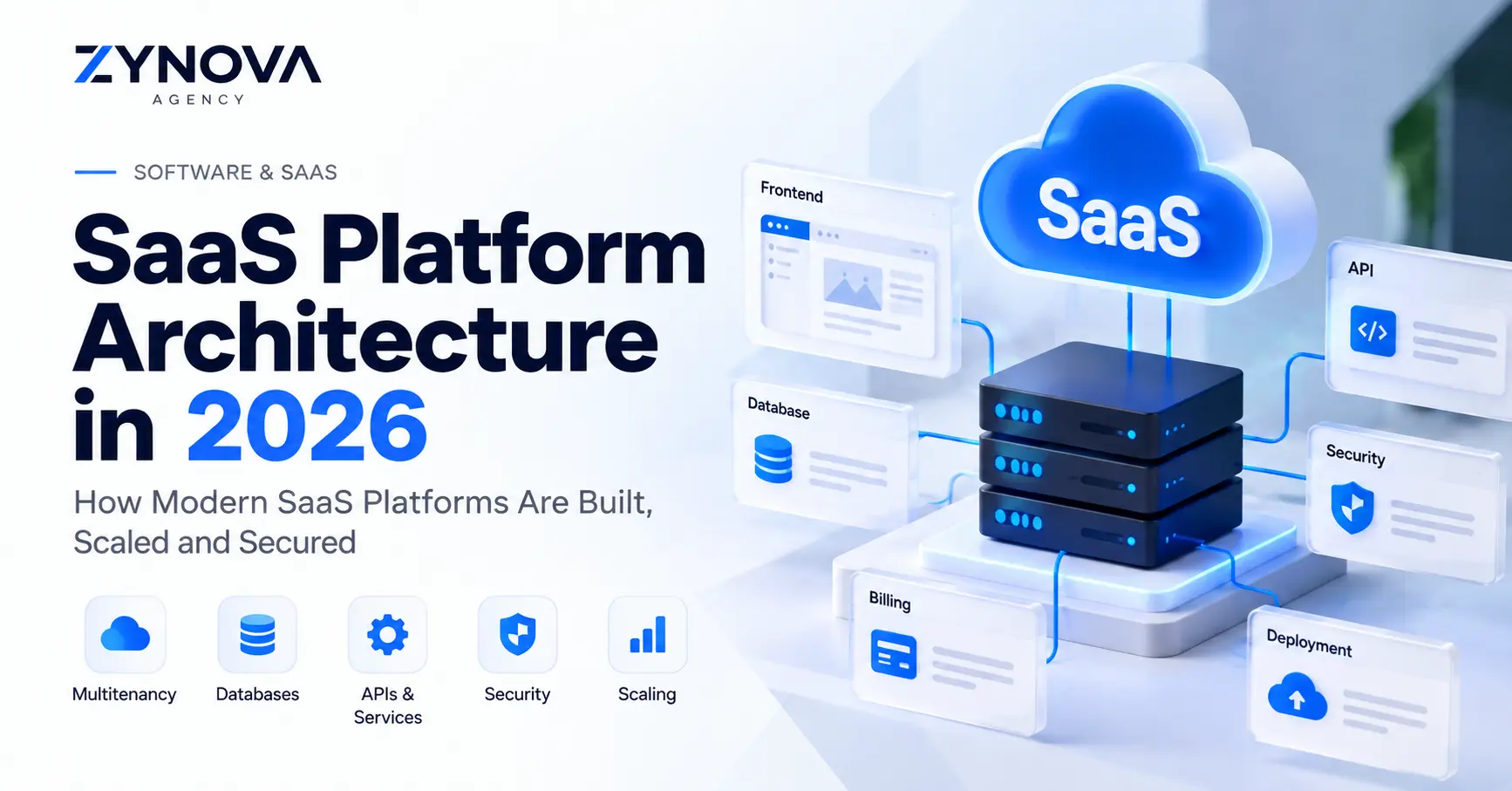
Building a SaaS product is very different from building a normal website.
A modern SaaS application may need to serve hundreds or thousands of customers from the same platform while keeping each customer’s users, permissions, data, billing, settings and activity properly separated.
That is where SaaS platform architecture becomes important.
A well-designed architecture allows a SaaS product to grow without rebuilding the entire system every time customer numbers increase. It should support secure access, reliable performance, subscription plans, automated deployments, monitoring and future feature development.
Microsoft makes an important distinction: SaaS is primarily a business and delivery model, while multitenancy is an architecture approach often used to build SaaS products. A SaaS system does not have to share every resource between every customer.
This guide explains how modern SaaS platforms are commonly designed in 2026 and which architectural decisions matter most before development begins.
What Is SaaS Platform Architecture?
SaaS platform architecture is the technical structure behind a software-as-a-service product.
It defines how the frontend, backend, APIs, databases, authentication, billing, infrastructure, security and deployment systems work together.
Imagine a business management SaaS used by 500 companies.
Each company might have multiple employees. Every company may need its own products, customers, invoices, reports, permissions and settings.
The software must know which organization every request belongs to and prevent one customer from accessing another customer’s information.
At the same time, the platform owner needs to manage subscriptions, plans, system updates, analytics, support and infrastructure from a central system.
A good SaaS architecture therefore has to balance several things at once: scalability, isolation, security, operating cost, performance and ease of development.
Microsoft’s current multitenancy guidance specifically notes that these choices involve trade-offs between isolation, scale, implementation complexity, performance and cost efficiency.
1. Start With the SaaS Business Model
The first architecture decision should not be which programming language or cloud provider to use.
Start with the business model.
You need to understand who the customers are, what they are paying for and how they will use the system.
A B2B SaaS platform might treat each company as one tenant. That company may then have an owner, managers, employees and other roles.
A consumer SaaS product may define tenants differently.
This matters because the tenant model affects almost every other part of SaaS platform architecture, including permissions, databases, subscriptions, usage limits and reporting.
Suppose your SaaS has three plans: Starter, Business and Professional.
Starter customers may receive one user and limited storage. Business customers may receive several users and more features. Professional customers may need multiple branches, advanced reporting or dedicated resources.
Those commercial decisions eventually become technical requirements.
Microsoft’s SaaS design methodology recommends aligning architectural decisions with the business model and customer requirements instead of treating architecture as a purely technical exercise.
If you are planning a new product and need the technical platform built around your business model, Zynova’s SaaS development services are designed around this type of requirement.
2. Choose the Right Multitenancy Model
One of the biggest decisions in SaaS platform architecture is how customers share infrastructure.
There is no single model that is correct for every SaaS product.
A pooled approach allows multiple tenants to share infrastructure and often the same database structures. This can be cost-efficient and easier to operate at scale.
A siloed model gives individual tenants dedicated resources. This can provide stronger isolation but normally costs more and creates additional operational work.
A hybrid model uses both approaches.
For example, normal customers might use shared infrastructure while a large enterprise customer receives a more isolated deployment because of compliance, performance or contractual requirements.
Azure’s architecture guidance describes exactly this spectrum: resources can be highly shared, fully isolated or designed somewhere between those extremes.
The correct choice depends on the product.
Do not choose separate databases for every customer simply because it sounds more secure. Likewise, do not place every customer into one shared environment simply because it is cheaper.
Choosing the right SaaS platform architecture early can prevent expensive restructuring as the product grows.
Architecture should reflect actual security, compliance, performance and business requirements.
3. Separate the Main Platform Layers
A scalable SaaS application becomes easier to maintain when responsibilities are separated clearly.
The user interface should not contain your core business rules.
The database should not become the only place where business logic exists.
Authentication should not be mixed randomly throughout unrelated application code.
A modern SaaS platform commonly contains a frontend application, an API or backend layer, business services, a data layer, authentication and authorization, background workers, billing services, notifications, storage and infrastructure services.
The exact technologies can vary.
A frontend might use React, Next.js or another framework. The backend could use PHP, Node.js, Python, .NET, Java or another technology. Data could be stored in PostgreSQL, MySQL, SQL Server, NoSQL systems or a combination.
The technologies themselves matter less than maintaining clear boundaries.
That makes future development easier because one part of the application can evolve without unnecessarily breaking another.
For businesses that need operational systems rather than an off-the-shelf SaaS product, Zynova also provides custom software development for systems built around specific workflows.
4. Make Every Request Tenant-Aware
One of the most important concepts in SaaS platform architecture is tenant context.
When a user signs in, the system should know which tenant that user belongs to and what they are allowed to do.
Consider a request to retrieve invoices.
The backend should not simply ask:
“Which invoices have this user ID?”
It also needs to establish the user’s verified organization or tenant context and apply the appropriate authorization rules.
This becomes even more important when services communicate with one another.
AWS’s SaaS architecture guidance recommends carrying tenant context through multi-tenant services so each service can correctly apply tenant-specific policies.
OWASP also warns against trusting a tenant identifier supplied by the client as proof of authorization. Tenant context should be established from authenticated and server-verified information.
This protects the platform against one of the most dangerous SaaS failures: a user from Company A gaining access to Company B’s information.
5. Design Data Isolation Carefully
Data isolation is one of the areas where SaaS development can go badly wrong.
Imagine two companies using the same invoicing SaaS.
A database query accidentally runs without the correct tenant restriction.
Company A could potentially receive records belonging to Company B.
That is not a normal display bug. It is a serious security problem.
A shared database can still be appropriate, but the isolation strategy must be designed intentionally.
Tenant ownership might be enforced using tenant-scoped queries, database policies, separate schemas, dedicated databases or a hybrid approach depending on the risk and compliance requirements.
OWASP’s current Multi-Tenant Application Security guidance discusses shared tables, separate schemas, separate databases and hybrid strategies, while emphasizing that the tenant boundary has to be enforceable.
Isolation also applies outside the main database.
Cache entries, uploaded files, queues, reports and background jobs may contain tenant-specific data.
For example, a cache key should not simply be:
customer-list
when every tenant has a different customer list.
It should be scoped appropriately so one tenant’s cached result cannot accidentally appear for another tenant.
6. Do Not Use Microservices Just Because They Sound Modern
Microservices are common in discussions about modern SaaS development.
That does not mean every new SaaS product should start with 30 independent services.
Early-stage products often benefit from a simpler architecture because the product itself is still changing.
A well-organized modular application can be easier to build, test and deploy while the company is finding product-market fit.
Services can later be separated when there is a real reason, such as independent scaling, different reliability requirements, clear team ownership or heavy workloads.
For example, reporting may eventually need to scale differently from billing.
Email processing might become a background service.
AI processing may require separate infrastructure.
Search may eventually need its own specialized system.
At that stage, separating those workloads can make architectural sense.
AWS documents multi-tenant microservices as one valid SaaS pattern, but its guidance also emphasizes tenant context, isolation and operational considerations rather than suggesting that microservices alone make a platform scalable.
Good SaaS platform architecture should solve business and engineering problems instead of following fashionable terminology.
7. Design for Scale Without Overbuilding
A new SaaS product might initially have 20 customers.
Eventually it could have 20,000.
The architecture should allow growth without requiring the company to pay for infrastructure it does not yet need.
Cloud services make this easier because compute, databases, storage and background processing can often scale independently.
Serverless infrastructure can also be useful for workloads where demand changes significantly.
AWS notes that serverless SaaS can reduce operational overhead and allow resources to scale more closely with actual usage.
Containers are another option when applications require more control over runtime environments and deployment.
Neither approach is automatically better.
The correct choice depends on workload characteristics, team knowledge, cost, portability and operational requirements.
Modern SaaS platform architecture should also protect against the “noisy neighbor” problem.
If one large tenant suddenly performs thousands of expensive operations, other customers should not experience severe performance problems.
Rate limits, usage quotas, queues, resource isolation and capacity controls can help prevent one tenant from consuming an unfair share of shared infrastructure.
8. Build Billing and Feature Entitlements Into the Platform
Subscription billing should not be treated as a button added at the end of development.
A SaaS platform needs to understand what each customer purchased.
Suppose your plans allow different numbers of users, branches, products or monthly transactions.
The backend needs a reliable entitlement layer that answers questions such as:
Can this tenant create another user?
Does this plan include this feature?
Has the subscription expired?
Is this tenant in a trial?
Has the tenant exceeded its usage allowance?
These checks should happen on the server side, not only by hiding buttons in the interface.
Billing providers can handle payment collection, but your application still needs to translate subscription status into product access.
That makes billing, subscription lifecycle and feature entitlements important parts of SaaS platform architecture rather than separate administrative tasks.
9. Automate Deployment and Operations
A SaaS company does not install new software manually for every user each time an update is released.
A modern platform should have a reliable deployment process.
Code changes should move through development, testing and production environments in a controlled way.
Database migrations should be repeatable.
Infrastructure should be reproducible.
Deployments should be monitored.
Rollback procedures should exist in case a release causes problems.
Azure’s current SaaS workload guidance specifically treats DevOps, governance, incident management, billing and cost management as core operational design areas rather than afterthoughts.
As the customer base grows, manual operations become increasingly risky.
If onboarding every customer requires a developer to create database entries, configure permissions and send credentials manually, growth creates more opportunities for mistakes.
Good automation lets the operating workload scale with the customer base.
10. Build Tenant-Aware Monitoring
Normal application monitoring asks:
“Is the server working?”
SaaS monitoring needs to answer more detailed questions.
Which tenant is experiencing the error?
Which feature caused it?
Is the problem affecting everyone or only one account?
Did a particular tenant suddenly consume unusually high resources?
Are login failures increasing?
Is a background queue delayed?
Which deployment introduced the problem?
This is why logs and metrics should include tenant context where appropriate without exposing sensitive customer data.
AWS includes tenant-aware operations and tenant activity among the major areas SaaS architects should consider.
A strong monitoring system makes support faster because the team can diagnose the affected customer without manually searching through unrelated events.
It also helps businesses understand how customers actually use the platform.
11. Treat Security as Part of the Architecture
Security should begin during architecture design rather than after the SaaS application is complete.
Authentication answers:
“Who are you?”
Authorization answers:
“What are you allowed to do?”
Tenant isolation answers:
“Which organization’s resources are you allowed to access?”
All three are essential.
The current OWASP Top 10 lists Broken Access Control as its highest-ranked web application risk category, while Security Misconfiguration and Software Supply Chain Failures also appear near the top.
For SaaS systems, access control becomes even more important because multiple customers may share infrastructure.
Security controls should exist at trusted server-side boundaries.
Do not assume that hiding an admin button prevents a normal user from calling the same API.
Do not assume that changing a tenant ID in a URL is harmless.
Do not assume an internal API is automatically safe.
Modern SaaS platform architecture should use least-privilege permissions, secure authentication, encrypted communication, validated inputs, safe secrets management, backups, logging and strong tenant isolation.
Security testing should also verify that one tenant cannot access another tenant’s records.
12. Design for Reliability and Recovery
Customers increasingly depend on SaaS platforms for daily business operations.
If the application becomes unavailable, their work may stop.
Reliability therefore needs to be part of the architecture.
Databases need backups.
Important workloads may require redundancy.
External service failures should be handled gracefully.
Background jobs should support retries without creating duplicate transactions.
Monitoring should detect failures quickly.
Recovery procedures should be tested rather than simply documented.
Azure’s SaaS design guidance recommends explicitly designing around reliability, security, performance efficiency and operational requirements because SaaS failures affect both the software vendor and its customers.
The level of resilience depends on the product.
A small productivity tool may have different requirements from software handling hospital, financial or enterprise operations.
The important point is to decide intentionally instead of discovering the requirement after a major outage.
What Does a Modern SaaS Request Look Like?
A normal user action can pass through several layers.
A user signs in and receives an authenticated session. The application establishes their tenant and role. The frontend sends a request to the API. The backend verifies the user’s permissions and tenant context. The appropriate service processes the business rule. The data layer retrieves only information authorized for that tenant. Logs capture relevant operational context, and the result is returned to the interface.
If the action triggers additional work, such as sending an invoice email or generating a report, a background worker may process that task separately.
All of this may happen in less than a second.
That is why users normally never see the complexity behind a well-built SaaS product.
Building the Right SaaS Architecture in 2026
The strongest SaaS platform architecture is not necessarily the one with the most technologies.
It is the architecture that fits the product.
A simple SaaS product may work extremely well with one application, one relational database and a few managed services.
A large platform may eventually require multiple services, queues, distributed databases, containers, dedicated tenant environments and sophisticated observability.
Both can be correct.
Start with the business model.
Define the tenant.
Decide what must be shared and what must be isolated.
Build secure authorization.
Design data boundaries carefully.
Automate operations.
Measure usage.
Scale individual parts when the product actually requires it.
That creates a platform capable of evolving without unnecessary complexity.
A scalable SaaS platform architecture should support growth without adding unnecessary technical complexity.
If you are planning a subscription product, membership system, business platform or other cloud software, explore Zynova Agency’s SaaS development services, view examples of digital systems we have built, or contact Zynova Agency to discuss your project.
Frequently Asked Questions
What is SaaS platform architecture?
SaaS platform architecture is the technical structure used to deliver software as an online service. It includes the frontend, backend, APIs, databases, authentication, tenant isolation, billing, infrastructure, security, monitoring and deployment processes.
What is multitenancy in SaaS?
Multitenancy means that at least some application resources are shared between multiple customers or tenants. It does not require every component to be shared. Microsoft specifically distinguishes SaaS as a business model from multitenancy as an architecture concept.
Should every SaaS application use microservices?
No. Microservices can be useful when services need independent scaling, deployment or team ownership, but they also add operational complexity. A modular monolithic architecture may be more practical for many early-stage SaaS products.
Should every SaaS customer have a separate database?
Not necessarily. SaaS systems can use shared databases, separate schemas, dedicated databases or hybrid models. The correct approach depends on isolation, compliance, performance, scale and operating cost.
What is the most important security issue in a multi-tenant SaaS platform?
Tenant isolation is one of the most important SaaS-specific concerns. The platform must ensure that a user or service operating within one tenant cannot access another tenant’s protected resources. OWASP provides dedicated multi-tenant security guidance for this problem.
Can SaaS architecture be changed later?
Yes, and good architecture should expect change. A platform might begin with mostly shared infrastructure and later isolate certain workloads or enterprise tenants as customer, compliance or scaling requirements evolve.