
Best Website Builders: 10 Powerful Picks for 2026
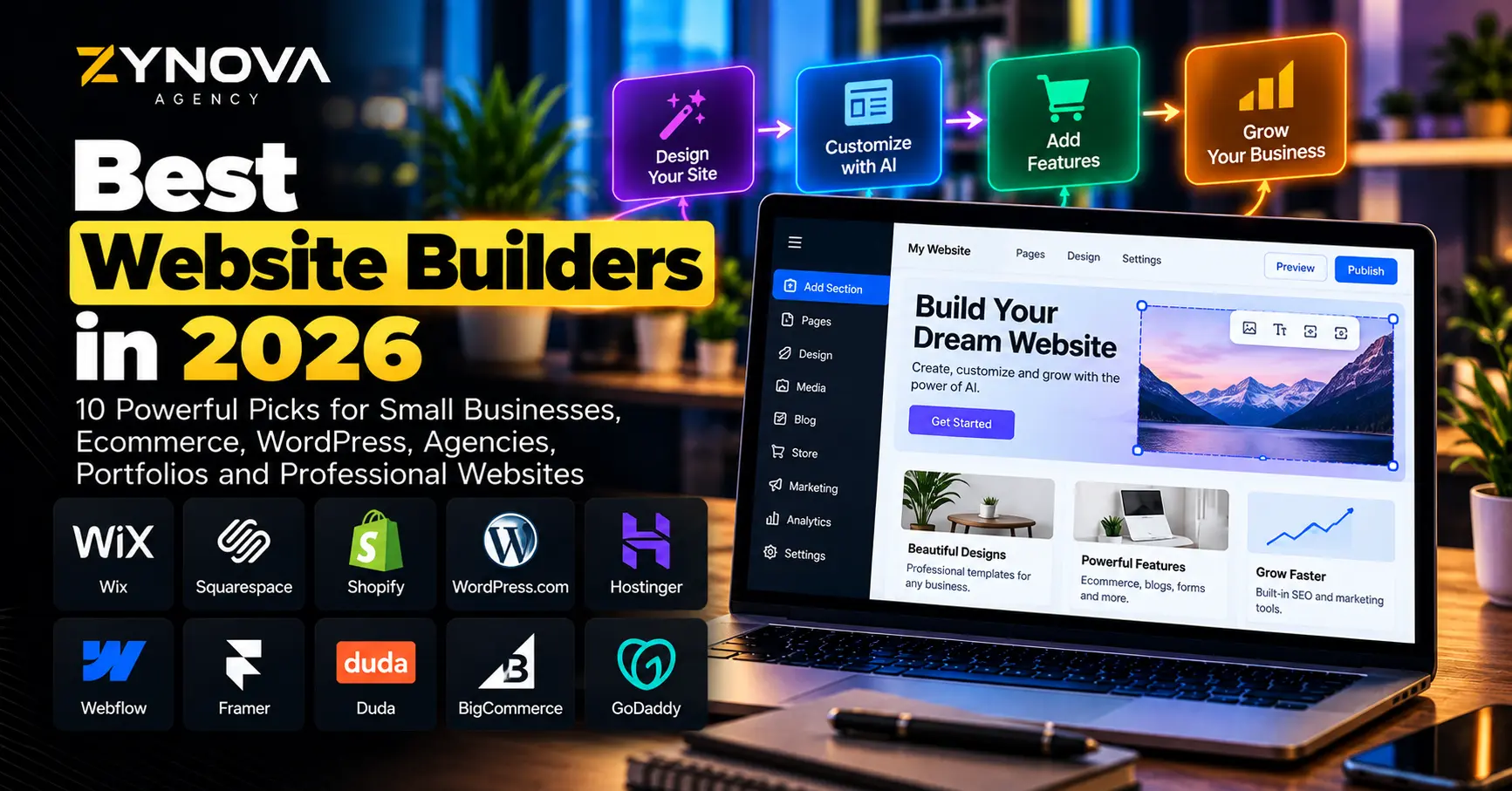
Choosing one of the best website builders in 2026 is no longer simply a matter of selecting a template and changing the text.
Modern website platforms can handle design, hosting, domains, ecommerce, blogging, SEO, analytics, AI-assisted creation, customer forms and even more advanced business functionality.
The challenge is that different platforms are built for very different users.
A photographer may care most about visual design. An ecommerce company needs powerful product and checkout features. An agency needs reusable components and client-management tools. A publisher may value content ownership and blogging flexibility more than a visual drag-and-drop editor.
AI has also changed the market significantly. Wix can now generate business-ready websites from prompts, Webflow can generate multi-page sites with reusable design systems, WordPress.com offers conversational AI site building, and GoDaddy has expanded its builder toward full-stack sites and applications.
But AI alone does not determine which platform is best.
This guide compares 10 of the best website builders available in 2026 based on their broader ability to build, manage and grow a real website.
Best Website Builders at a Glance
| Website Builder | Best For | Main Strength |
|---|---|---|
| Wix | Most small businesses | Flexible all-in-one website and business platform |
| Squarespace | Visual brands | Professional design and polished templates |
| Shopify | Ecommerce | Complete online selling ecosystem |
| WordPress.com | Blogging and publishing | Powerful content ecosystem and flexibility |
| Hostinger | Value and beginners | Affordable website, hosting and AI tools |
| Webflow | Professional designers | Advanced design control and scalable structure |
| Framer | Startups and portfolios | Modern design and fast visual editing |
| Duda | Agencies | Client management, reusable sites and white labeling |
| BigCommerce | Larger ecommerce | Advanced commerce and catalog capabilities |
| GoDaddy | Fast business setup | Simple all-in-one business website creation |
How We Chose the Best Website Builders
The best website builders should remain useful after the initial homepage has been created.
A generated design may look impressive, but businesses eventually need to change pages, publish content, connect analytics, improve SEO, accept payments and maintain the website.
For this comparison, the main considerations are design flexibility, ease of use, blogging, ecommerce, SEO controls, hosting, performance, AI capabilities, scalability and long-term maintainability.
The right platform is the one that fits the website you actually need to operate.
1. Wix — Best Website Builder for Most Small Businesses
Wix is one of the most complete all-in-one website platforms available.
Its current AI website builder allows users to describe their business and generate a business-ready site. Wix also lets users move between AI-assisted editing and normal visual drag-and-drop customization.
That combination is important.
Some AI builders are extremely fast initially but become restrictive when users want to customize the generated result.
Wix attempts to combine both workflows.
A small business can start with AI, manually modify individual elements and continue adding business functionality later.
Wix can support websites for restaurants, service companies, consultants, portfolios, ecommerce stores, bookings and many other small-business use cases.
Its broader ecosystem includes business tools rather than treating the website as an isolated set of pages.
That makes Wix one of the best website builders for business owners who want most of their website operations inside one platform.
The trade-off is that businesses needing highly specialized backend systems may eventually require something more custom.
Best for: small businesses, service companies, freelancers, restaurants and general business websites.
2. Squarespace — Best for Beautiful Business Websites
Squarespace has built much of its reputation around visual design.
Its website platform provides designer-created templates, pre-built page layouts and Blueprint AI for generating websites around a brand and business direction.
Squarespace is particularly strong when visual presentation plays a major role in the website.
That can include:
Photography portfolios, architecture studios, restaurants, consultants, personal brands and creative businesses.
The platform includes blogging, commerce, scheduling and marketing capabilities in addition to the core website editor.
One reason Squarespace remains among the best website builders is consistency.
A user without professional design experience can generally produce a site that feels relatively polished because the platform places strong visual constraints around typography, spacing and layout.
Those constraints can also be a disadvantage for users who want very unusual layouts or deeper custom development.
But for design-focused businesses, they often help rather than hurt.
Best for: portfolios, photographers, consultants, restaurants and visual brands.
3. Shopify — Best Website Builder for Ecommerce
Shopify should be considered differently from a normal website builder.
Its primary purpose is commerce.
That means products, inventory, payments, checkout, orders and customer management are at the center of the platform instead of being optional additions.
Shopify’s current AI Store Builder can generate personalized store designs from a short business description, while the resulting store operates on Shopify’s wider commerce infrastructure.
This makes Shopify one of the best website builders when selling products is the main objective.
A normal business website may prioritize:
About pages, services, portfolios and contact forms.
An online store needs:
Products, variants, inventory, shipping, taxes, discounts, payment processing and checkout.
Shopify is designed around those requirements.
It also has a large app and theme ecosystem that businesses can use to extend functionality.
For a simple service website, Shopify may be unnecessary.
For a serious online retail business, however, choosing a commerce-first platform can be much more practical than forcing ecommerce functionality into a general website builder.
Businesses that require a more customized selling experience can also explore Zynova Agency’s ecommerce development services.
Best for: online stores, product brands, dropshipping and ecommerce businesses.
4. WordPress.com — Best for Blogging and Content-Driven Websites
WordPress remains one of the most important website ecosystems for publishing.
WordPress.com has also changed significantly with the addition of AI-assisted website creation.
Its AI website builder can generate a complete website from a conversation, and users can then continue modifying pages, navigation, colors, sections and content with AI or normal WordPress editing.
In September 2026, WordPress.com also expanded its AI builder with custom AI-generated themes on selected plans.
The main advantage remains the WordPress ecosystem.
A website can grow from a simple blog into a more complex content platform through themes, plugins and additional functionality.
WordPress is particularly strong for businesses planning to publish significant amounts of content.
That could include:
Blogs, magazines, educational sites, affiliate websites, documentation and content-heavy company websites.
Among the best website builders, WordPress.com is particularly attractive when publishing and long-term content flexibility matter more than getting the simplest possible editor.
Best for: blogs, publishers, content businesses and websites expected to grow over time.
5. Hostinger Website Builder — Best for Value
Hostinger combines website creation and hosting inside one relatively affordable environment.
Its current Website Builder includes hundreds of templates, drag-and-drop editing, AI content tools, SEO features and ecommerce on supported plans. Hostinger’s current Pakistan pricing page lists more than 400 templates on its website-builder plans.
Hostinger has also been moving more heavily into agentic website creation.
Its 2026 AI Builder is intended to help users not only create a website but increasingly build and manage the systems behind online projects using AI.
For beginners, convenience is the major advantage.
Hosting, templates, a domain on eligible plans, website creation and related tools can exist inside the same account.
That makes Hostinger one of the best website builders for users who want to keep initial complexity and cost relatively low.
The main caution is pricing.
Promotional rates can differ significantly from long-term renewal pricing, so compare the actual renewal cost before purchasing a multi-year plan.
Best for: beginners, small businesses, portfolios and budget-conscious websites.
6. Webflow — Best for Professional Website Design
Webflow is aimed more heavily at professional designers and advanced marketing teams.
Its visual development environment provides significantly deeper control over layout and responsive design than many traditional beginner website builders.
Webflow’s current AI Site Builder can generate a multi-page website from a prompt, including site structure, copy and a foundational design system. Generated sites use Webflow’s Flowkit framework, giving users reusable components and variables rather than only a static AI-generated layout.
Webflow has also added AI capabilities for SEO and AEO, CMS content, copy and code components.
This makes it one of the best website builders for companies that care deeply about design systems and structured websites.
A professional marketing website might contain dozens of reusable components.
Instead of changing button styles separately on every page, a design system lets the team make more centralized changes.
The trade-off is learning curve.
Webflow gives users more control, but that control means there is more to understand.
Best for: agencies, professional designers, marketing websites and sophisticated company sites.
7. Framer — Best for Startups, Landing Pages and Portfolios
Framer has become especially popular for modern product and startup websites.
Its visual canvas feels closer to professional design software than a conventional template-based website builder.
Framer’s AI website builder can generate structure, sections and initial copy from a prompt or campaign brief. The generated website remains fully editable on the Framer canvas.
Framer also includes CMS functionality, SEO controls, hosting, performance optimization, analytics and responsive-design capabilities.
This combination makes Framer one of the best website builders for design-focused teams that want to launch quickly.
It is particularly strong for:
SaaS landing pages, startup websites, portfolios, product launches and creative agencies.
A complex ecommerce business or highly specialized application may need a different platform.
But for polished marketing websites, Framer offers an attractive balance between speed and visual control.
Best for: startups, SaaS businesses, landing pages, portfolios and modern brand sites.
8. Duda — Best Website Builder for Agencies
Duda is built heavily around agencies and businesses producing websites for clients.
Its platform includes reusable templates and sections, responsive design, CMS functionality, developer tools and white-label capabilities.
White labeling is particularly important for agencies.
Instead of telling a client to log into someone else’s branded website builder, an agency can provide a more customized client experience.
Duda also supports reusable site components.
If an agency builds similar websites for restaurants, dentists or local service companies, reusable templates and sections can reduce production time.
In 2026, Duda expanded its AI functionality further, including full-site generation and custom widget generation.
The platform also supports AI-generated SEO metadata and image alt text.
That makes Duda one of the best website builders for agencies that care about production efficiency, client management and repeatable systems.
Best for: web agencies, freelancers, multi-client management and white-label websites.
9. BigCommerce — Best for Larger and More Complex Online Stores
BigCommerce is another commerce-focused platform, but it often appeals to more complex retail requirements.
Modern ecommerce systems need much more than product pages.
BigCommerce’s current guidance highlights essential commerce functions including product catalogs, shopping carts, checkout, inventory, order management and mobile-friendly storefronts.
BigCommerce becomes particularly relevant when businesses have more complex catalogs, integrations or B2B requirements.
This can include companies dealing with:
Large product ranges, wholesale buyers, complicated inventory and multiple sales channels.
For a tiny store selling five products, a simpler solution may be easier.
For a growing ecommerce operation, choosing infrastructure designed specifically for commerce can prevent problems later.
BigCommerce therefore earns a place among the best website builders when ecommerce complexity matters more than beginner simplicity.
Best for: larger ecommerce stores, B2B commerce and complex product catalogs.
10. GoDaddy Website Builder — Best for Getting a Business Online Quickly
GoDaddy’s website builder has changed substantially in 2026.
Its current Airo AI Builder can generate websites, pages, databases and logic from conversational prompts, while users can still modify designs manually. GoDaddy also says users can download their code on paid plans.
For small businesses, its attraction is convenience.
GoDaddy can combine:
Website creation, domains, hosting, forms, payments, appointments and marketing tools.
The platform also includes mobile-friendly design and ecommerce functionality.
This makes GoDaddy one of the best website builders for businesses that simply want to get online without assembling many separate services.
Its newer full-stack AI capabilities make it more ambitious than the basic template builder it was historically known for.
However, professional designers may still prefer platforms such as Webflow or Framer when precise visual control matters more than simplicity.
Best for: local businesses, first websites, portfolios and fast business launches.
Website Builder vs AI Website Builder
There is now significant overlap between these categories.
Most major website builders have introduced AI.
The difference is what happens after generation.
A good website builder needs to remain useful when you want to:
Add another service page.
Publish 100 blog posts.
Change the navigation.
Launch ecommerce.
Improve SEO.
Install integrations.
Redesign the homepage.
Add customer accounts.
Track conversions.
That is why this guide is intentionally different from Zynova’s comparison of the best AI website builders in 2026.
The AI guide focuses more heavily on AI-assisted creation.
This article focuses on the overall website platform you will continue using after the first design has been generated.
Which Website Builder Is Best for Small Businesses?
Wix is a strong general-purpose option because it combines site creation with a broad collection of business tools.
Squarespace is attractive when branding and design matter heavily.
Hostinger can be a strong value choice.
GoDaddy can work well when the objective is simply to launch quickly.
But business requirements should come first.
A restaurant may need online reservations.
A consultant may need lead forms.
A salon may need appointment booking.
A real estate company may need custom listing functionality.
The best website builders are those that support the actual customer journey rather than simply producing an attractive homepage.
Which Website Builder Is Best for Ecommerce?
Shopify should be one of the first options considered when ecommerce is the primary business model.
BigCommerce is particularly relevant for larger or more complex commerce operations.
Wix and Squarespace can work well for smaller stores.
WordPress combined with WooCommerce offers another route for businesses that want greater control.
The right platform depends on factors such as:
Catalog size, inventory complexity, payment requirements, shipping, integrations and long-term growth.
If your ecommerce requirements are more specialized, Zynova Agency’s ecommerce development services may be a better fit than forcing a complicated business process into a standard builder.
Which Website Builder Is Best for SEO?
No website builder automatically guarantees SEO rankings.
The platform should allow you to control important elements such as:
SEO titles, meta descriptions, URLs, redirects, headings, image alt text, sitemaps and indexing settings.
But those controls only provide the technical foundation.
Actual SEO results still depend on content, search intent, authority, internal linking, performance and competition.
Webflow, WordPress, Wix and other major platforms now provide substantial SEO functionality.
The more important question is whether your team understands how to use it.
For the strategy itself, read Zynova’s guide on how to improve website SEO in 2026.
Which Website Builder Is Best for Blogging?
WordPress remains particularly strong for publishing.
The platform was built around content and has developed into a much broader CMS ecosystem.
Squarespace, Wix, Webflow and other builders also provide blogging functionality.
The decision becomes more important when the website expects hundreds or thousands of articles.
At that point, content organization, categories, authors, templates, search and long-term management matter more than whether the first blog page looked attractive.
For content-heavy projects, evaluate the CMS before evaluating the homepage design.
Which Website Builder Is Best for Agencies?
Webflow, Duda and WordPress are particularly relevant to agencies.
Duda is especially focused on repeatable client-site production and white labeling.
Webflow is strong when the agency produces custom, design-heavy marketing websites.
WordPress remains useful when clients need extensive plugin functionality or content management.
Framer is becoming increasingly relevant for agencies producing startup and SaaS marketing sites.
The best website builders for agencies should support collaboration, reusable components, staging and efficient ongoing maintenance.
Website Builders vs Custom Web Development
Website builders are much more capable than they were a few years ago.
Many businesses do not need custom development.
A normal business website, portfolio, blog or small store can often be built faster and more economically using an established platform.
Custom development becomes more appropriate when the project needs:
Unique databases, advanced dashboards, specialized integrations, complex user roles, custom workflows, proprietary business logic or SaaS functionality.
For example, a five-page company website probably does not need a custom software stack.
A platform where hundreds of customers log in, manage data and perform industry-specific operations may.
Zynova Agency’s web development services cover professional website projects, while custom software development is more appropriate when the project goes beyond normal website functionality.
The objective should be choosing the simplest technology that properly supports the business requirement.
Do Not Choose a Website Builder Based Only on AI
AI can save considerable time.
It can generate:
Page structures, first-draft copy, images, layouts and design ideas.
But those features are becoming common.
The long-term questions are more important.
Can you export or migrate your content?
Can the website grow?
Can you manage SEO?
Can you integrate your business software?
Can you create new pages easily?
Can several employees work on the site?
Can you handle ecommerce?
What happens when your requirements change?
The best website builders should still make sense after the novelty of AI generation wears off.
Consider Platform Lock-In
Website builders make life easier by managing infrastructure.
That convenience can create dependency on the platform.
Moving from one proprietary builder to another is rarely as simple as clicking an export button.
Design systems, CMS structures, ecommerce information and platform-specific functionality may need to be rebuilt.
WordPress tends to provide greater flexibility around hosting because the WordPress ecosystem is not tied to only one hosting company.
Hosted platforms such as Wix, Squarespace and Shopify trade some portability for easier management.
Neither approach is automatically wrong.
Just understand the trade-off before investing years of content and operations into a platform.
The Best Website Builder Should Match Your Future Plans
Do not choose only for today’s requirements.
Think about what the website may need in two or three years.
If you expect to launch ecommerce, confirm that the platform can support it.
If you expect hundreds of blog posts, examine the CMS.
If several team members will manage the website, check collaboration features.
If international expansion is likely, investigate multilingual functionality.
If custom business workflows may eventually be required, understand the platform’s APIs and integration options.
Choosing one of the best website builders is easier when you know where the business is going.
Which of the Best Website Builders Should You Choose?
There is no single platform that is ideal for every website.
Choose Wix for a flexible all-in-one small-business website.
Choose Squarespace when visual design is the priority.
Choose Shopify when ecommerce is the business.
Choose WordPress.com for publishing and content flexibility.
Choose Hostinger for an affordable all-in-one starting point.
Choose Webflow for professional design control.
Choose Framer for modern startup, SaaS and portfolio websites.
Choose Duda for agencies and repeatable client-site production.
Choose BigCommerce for more complex ecommerce operations.
Choose GoDaddy when fast and simple business setup is most important.
The best choice is the platform that supports your business after the website has launched—not simply the platform that creates the fastest first draft.
If you’re unsure whether your project should use a website builder, WordPress or custom development, contact Zynova Agency to discuss what the website actually needs.
Frequently Asked Questions
What are the best website builders in 2026?
Some of the best website builders in 2026 include Wix, Squarespace, Shopify, WordPress.com, Hostinger, Webflow, Framer, Duda, BigCommerce and GoDaddy. The best option depends on whether you need a business site, ecommerce store, blog, portfolio or agency workflow.
What is the best website builder for beginners?
Wix, Hostinger, Squarespace and GoDaddy are relatively beginner-friendly because they combine managed hosting with visual editing and AI-assisted creation.
What is the best website builder for small businesses?
Wix is a strong general-purpose option for many small businesses. Squarespace is particularly attractive for visual brands, while Hostinger and GoDaddy can provide simpler or more affordable starting points.
What is the best website builder for ecommerce?
Shopify is one of the strongest options for ecommerce-focused businesses because commerce is the core of the platform. BigCommerce is particularly relevant for larger or more complex stores.
What is the best website builder for SEO?
WordPress, Webflow, Wix and several other major platforms provide extensive SEO controls. Rankings depend more on how the site is optimized than on the builder alone.
What is the best website builder for agencies?
Duda, Webflow, WordPress and Framer are particularly relevant for agencies. Duda is especially focused on reusable client-site production and white-label workflows.
Is WordPress better than a website builder?
WordPress generally provides greater extensibility and hosting flexibility, while hosted website builders simplify infrastructure and maintenance. The better option depends on the project’s requirements.
Can AI build an entire website?
Yes. Several current platforms can generate multi-page websites from prompts. However, the result should still be reviewed for design, accuracy, SEO, conversion and business requirements. Webflow and WordPress.com both currently support AI-assisted multi-page site creation.